Why Coding Is No Longer the Most Important Skill in Schools
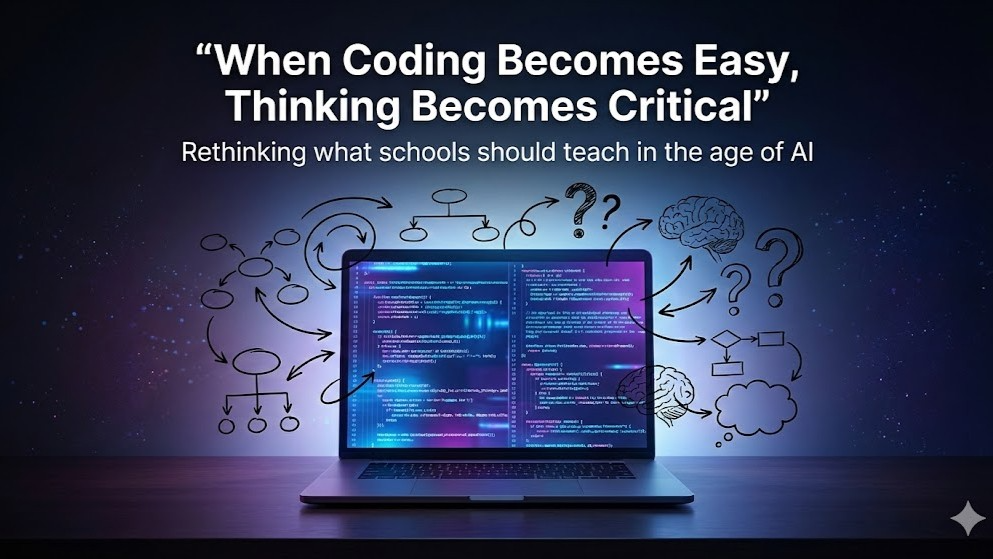
A thought-provoking article on why teaching coding alone is no longer enough in schools. It argues that while coding is useful, the real need is to develop thinking skills like problem-solving, systems thinking, AI literacy, and adaptability. The piece encourages schools to move from tool-focused education to a thinking-first approach that prepares students for an AI-driven future.
In 2020, schools rushed to introduce coding labs
In 2025, many realised something uncomfortable
Their students could code.
But they couldn’t think.
For the last decade, schools were told one thing repeatedly:
Every child must learn coding.
Parents believed it.
Schools invested in it.
Edtech companies built entire businesses around it.
Coding became the symbol of “future-ready education.”
But something strange started happening inside classrooms.
Students were learning syntax.
Teachers were teaching blocks.
Schools were showcasing coding labs.
Yet something deeper was missing.
Because the future was not asking for more coders.
The future was asking for something else entirely
The reality schools are now facing
Walk into any school today and observe quietly. You will likely notice:
- Students can follow coding instructions but struggle to explain their logic
- Teachers can use tools but hesitate to design learning experiences
- Schools adopt technology but fail to integrate it meaningfully
Coding exists in classrooms, but deeper conceptual understanding is often underdeveloped.
This is the gap that no curriculum brochure addresses.
Coding is a tool. Thinking is a skill.
The most future-ready students combine technical skills with:
- Critical thinking
- Contextual understanding
- Decision-making ability
Teaching coding without thinking is like teaching driving without navigation.
Students can move the car, but they don’t know where to go.
Many schools focus on:
- Dragging blocks
- Running scripts
- Debugging errors
But often overlook:
- Critical thinking
- Problem framing
- Collaboration
- Evaluating information
- Adapting to change
Coding trains technical skills.
The future demands deeper thinking abilities.
The uncomfortable truth about AI
AI changed the equation almost overnight.
Today:
- AI can write code
- AI can debug faster than students
- AI can build apps without deep syntax knowledge
As coding becomes automated, the human role shifts toward:
- Reasoning
- Creativity
- Judgment
- Ethical thinking
- Systems understanding
- Communication
- Learning how to learn
These are not “soft skills.”
They are survival skills.
Coding becomes an amplifier of human intelligence, not the end goal.
What schools actually need to teach now
If you map future demand instead of past trends, priorities shift.
The new core skills:
1. Problem framing
Learning to ask the right questions, not just solve predefined ones.
2. Systems thinking
Understanding how technology, society, and decisions connect.
3. Digital literacy
Knowing how tools influence thinking, not just how to use them.
4. AI literacy
Understanding how AI works, where it fails, and how to use it responsibly.
5. Collaboration and communication
Because real-world problems are rarely solved alone.
6. Adaptability
Because today’s syllabus can be outdated tomorrow.
Coding fits within this ecosystem.
It is no longer the ecosystem itself.
Why most schools struggle with this shift
Schools were built to teach subjects.
The future requires teaching systems.
Subjects are easy to timetable.
Systems are harder to design.
Schools often ask:
Which coding course should we buy?
Instead of:
What kind of thinking should our students develop?
They adopt tools but don’t redesign learning.
Technology enters classrooms, but pedagogy stays the same.
That’s why coding can feel important yet ineffective.
The Codju perspective: Skills are not modules, they are systems
In one school visit, students built a flawless Scratch project.
When asked why their solution worked, most stayed silent.
They knew how to execute.
They didn’t know how to explain decisions.
The insight:
- Schools don’t fail because they lack tools
- They fail because they lack thinking systems
ICT, AI, and coding are not just subjects.
They are infrastructure for thinking.
The goal is not to replace coding education but to embed it within a thinking-first framework that prepares students for real-world complexity.
A student learning AI without ethics is risky.
A student learning coding without thinking is limited.
A school using technology without teacher enablement is fragile.
The future of education is not:
More coding classes.
It is:
Better thinking architectures inside schools.
The question schools must ask now
Not:
Are we teaching coding?
But:
Are we preparing students for a world where coding is automated?
The most valuable students will not be those who can code.
They will be those who can use coding to solve meaningful problems.
Students who can:
- Understand complexity
- Work with AI
- Make decisions
- Think independently
- Build meaning, not just software
Coding will remain relevant.
But it will no longer be the crown.
It will be one tool in a much larger intelligence system.
The real shift education must acknowledge
The future is not programmable.
It is interpretable.
Schools that understand this early will not just survive.
They will lead.
The question is not whether students should learn coding.
It is how and why they learn it.