How AI is Actually Being Taught in Indian Schools Today
Artificial Intelligence (AI) in Indian schools is no longer a futuristic idea. It is already present in classrooms — but often in very different ways than people imagine. Some schools teach AI as a formal subject. Others use AI tools to support learning. Many are still figuring out what AI in education should really mean. This article explains how AI is actually being taught in Indian schools today, what’s working, what’s not, and what schools are learning along the way.
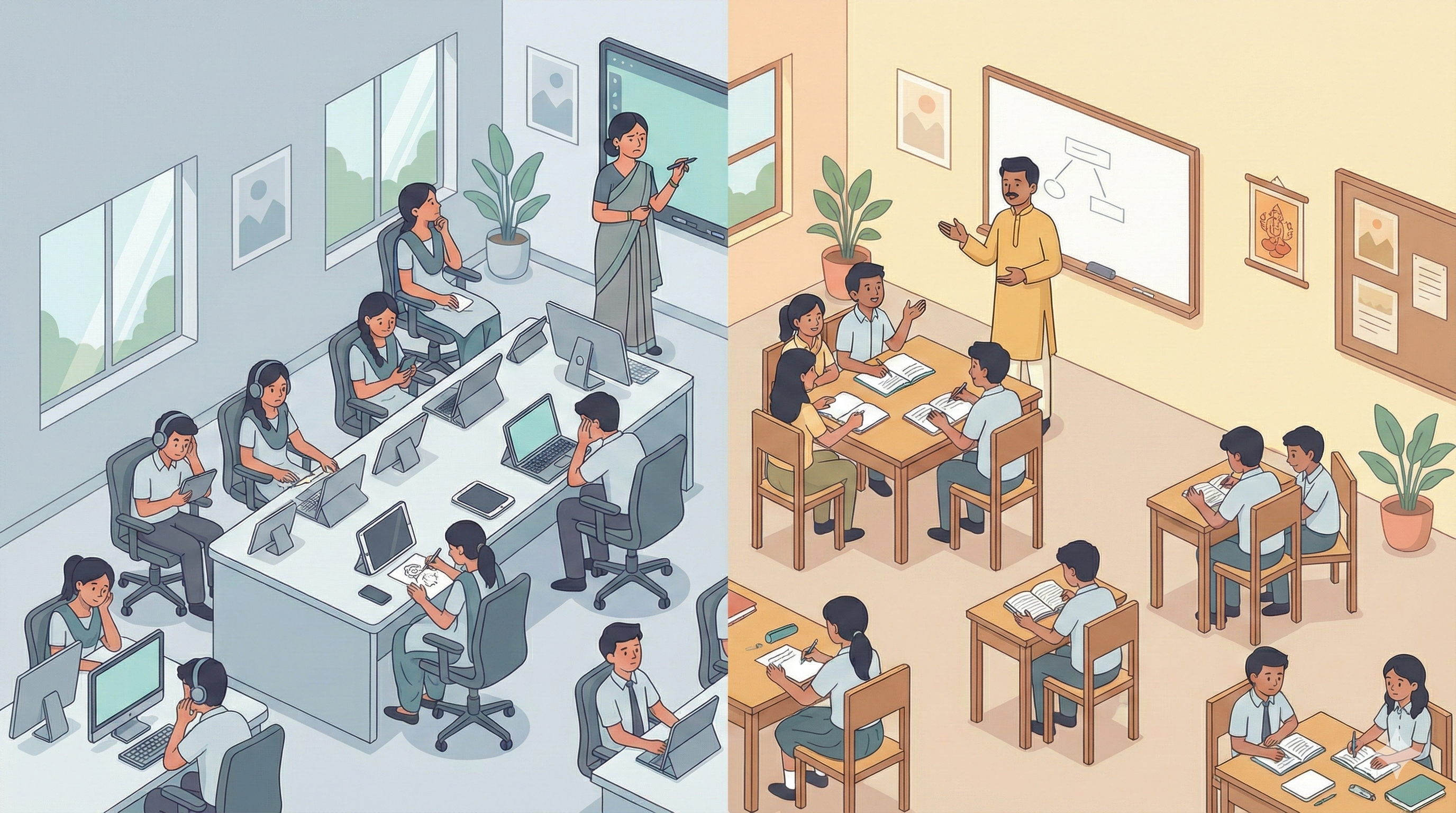
AI in Indian Schools: What’s Officially Happening
AI entered Indian school education largely through policy and board-level initiatives.
Under the National Education Policy (NEP) 2020, digital literacy, computational thinking, and emerging technologies like AI are emphasised as future skills. CBSE introduced AI as an elective subject for Class IX in 2019 and later extended it to higher classes. Thousands of schools now offer AI modules.
In many schools, AI education includes:
- Basics of AI and machine learning
- Ethics and responsible AI
- Real-world AI use cases
- Problem-solving and logical thinking
For younger students, AI is often introduced through computational thinking — learning how to break problems into steps and think logically.
However, having AI in the curriculum is only one part of the story.
What AI Teaching Looks Like on the Ground
On paper, AI education looks structured. On the ground, it varies widely.
1. Theory-heavy classrooms
In some schools, AI is taught like any other subject — through textbooks, notes, and exams. Students learn definitions but may not interact with real tools.
2. Tool-based exposure
Some teachers introduce students to tools like ChatGPT or other AI assistants for resolving doubts, conducting research, or explaining concepts. Students use AI to clarify concepts in geography, economics, or science during self-study.
This has helped many students become more self-reliant, especially in areas with limited teacher access.
But concerns remain about over-dependence and shallow learning if guidance is missing.
3. EdTech-led learning
Adaptive platforms and AI-powered quizzes personalise learning paths. These tools suggest content based on performance and help teachers track progress.
4. Administrative AI
Many schools’ first experience of AI is through automation — attendance, grading support, analytics dashboards — before teaching it to students.
The Real Challenges Schools Face
Despite rapid growth, AI education in India is uneven.
Teacher readiness
Many teachers are curious but hesitant. AI evolves quickly, and formal training is still catching up.
Infrastructure gaps
Not all schools have reliable devices or internet. Access remains a real constraint in many regions.
Misunderstanding AI
AI is sometimes seen as a shortcut or cheating tool rather than a learning aid. This creates resistance among educators and parents.
Screen-time concerns
Parents worry about increased device use, especially for younger children.
A Key Insight: AI Doesn’t Replace Teaching
Across schools, one pattern is clear:
AI works best when guided by teachers.
It works poorly when left unstructured.
Students benefit when AI is used to:
- Explain concepts patiently
- Provide practice questions
- Offer multiple explanations
- Support revision
But critical thinking, interpretation, and judgment still depend on human teaching.
Where Codju Fits In
Many schools struggle not because they lack tools, but because they lack continuity and structure.
This is where Codju positions itself differently.
Instead of treating AI as a standalone subject or a flashy add-on, Codju helps schools build a learning system where AI, ICT, and digital skills are:
- Structured across grades
- Aligned to NEP and NCF
- Supported by teacher training
- Designed for real classroom use
- Sustainable over time
Codju focuses on teacher enablement, curriculum design, and long-term implementation so that technology supports learning without disrupting classrooms.
For schools trying to move beyond one-off workshops or disconnected tools, this system-based approach is often what makes AI education actually work.
FAQs
Is AI compulsory in Indian schools?
AI is not yet universally compulsory, but many boards and schools are integrating it progressively within NEP-aligned frameworks.
Are students really learning AI?
Some are. Many are learning foundational thinking skills related to AI. Depth depends on the school’s approach and teacher support.
Will AI replace teachers?
No. AI can assist, but it cannot replace mentorship, judgment, or classroom relationships.
Do students misuse AI?
Sometimes. Like calculators or the internet, misuse exists. Structured guidance reduces this risk.
Is AI education only for elite schools?
Not necessarily. Adoption is growing across different types of schools, though access and training remain challenges.
The Bottom Line
AI is already in Indian schools. But meaningful AI education is not about teaching tools. It is about building systems that teach students to think, question, and apply technology responsibly.
Schools that succeed are not the ones with the most devices, but the ones with the most thoughtful implementation.
Increasingly, schools are realising that AI education works best when it is structured, supported, and sustained — not just introduced.
That shift is where the real story of AI in Indian schools is unfolding.