NCF 2023 Explained for School Leaders and Teachers
A Practical Guide to the National Curriculum Framework for School Education 2023

India’s education system is undergoing one of its most significant transformations in decades. At the centre of this change is the National Curriculum Framework (NCF) 2023, developed by NCERT to operationalise the vision of NEP 2020.
For school leaders and teachers, the real question is not “What is NCF 2023?”
It is:
• What changes in my classroom?
• What changes in my school processes?
• What changes in assessment and curriculum planning?
• And how do we implement this without overwhelming teachers?
This guide explains NCF 2023 clearly, practically, and from a school-implementation lens.
What is NCF 2023?
The National Curriculum Framework for School Education 2023 is a comprehensive guideline for school education in India for ages 3–18. It is based on the vision of the National Education Policy (NEP) 2020 and restructures the curriculum, pedagogy, assessment, and school culture.
As stated in the official document:
- It covers ages 3–18
- It reflects the 5+3+3+4 curricular structure
- It shifts focus from rote memorisation to competency-based learning
- It emphasises holistic development — knowledge, capacities, and values
NCF is not a textbook.
It is the framework that guides textbook creation, pedagogy, assessment, and school practices.
The Core Philosophy of NCF 2023
NCF 2023 is built around a simple but powerful shift:
From content accumulation → to capacity development.
From memory-based exams → to competency-based assessment.
From isolated subjects → to integrated, interdisciplinary learning.
From marks-driven schooling → to holistic development.
The framework identifies three core outcomes schools must develop:
- Knowledge (understanding concepts deeply)
- Capacities (skills like critical thinking, communication, problem-solving)
- Values & Dispositions (ethics, democratic participation, rootedness in India)
This means schools are no longer judged solely by syllabus completion but by how effectively students develop their thinking, creativity, and real-world competence.
The 5+3+3+4 Structure Explained
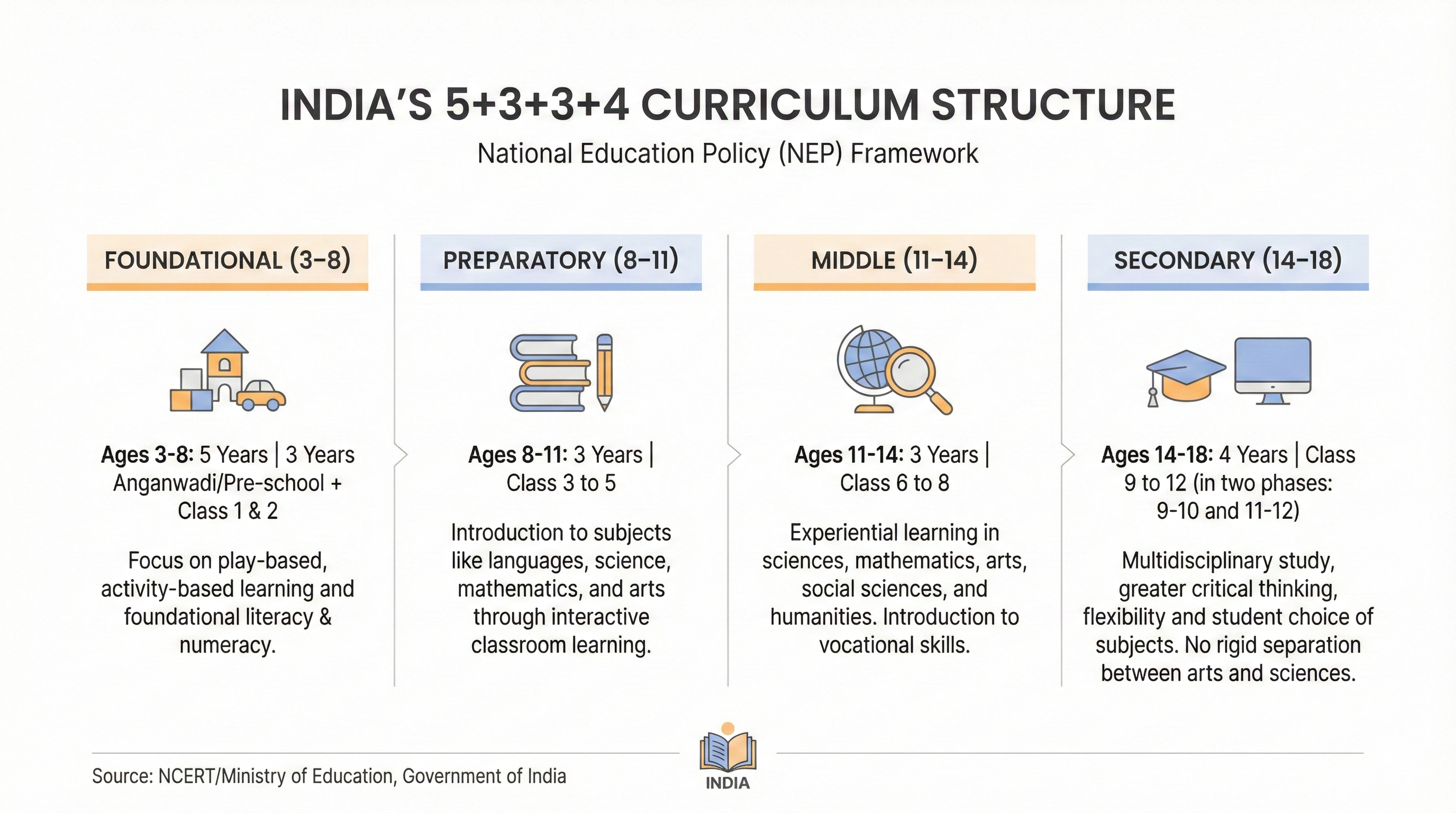
One of the most visible structural changes under NEP and NCF is the new curriculum structure.
1. Foundational Stage (5 years: Ages 3–8)
- 3 years of preschool/Anganwadi
- Grades 1–2
- Focus: Play-based learning, foundational literacy & numeracy (FLN), socio-emotional development
Five developmental domains include:
• Physical development
• Cognitive development
• Language & literacy
• Socio-emotional development
• Aesthetic & cultural development
This stage prioritises how children learn, not just what they learn.
2. Preparatory Stage (Grades 3–5)
- Discovery-based learning
- Introduction to light textbooks
- Strong foundation in language and mathematics
- More structured classroom learning
3. Middle Stage (Grades 6–8)
- Subject-based learning begins formally
- Introduction to coding, computational thinking
- Exposure to vocational education
- Experiential and project-based methods
4. Secondary Stage (Grades 9–12)
- Greater subject choice flexibility
- Interdisciplinary options
- Vocational integration
- Reduced emphasis on high-stakes board exams
For school leaders, this means timetable design, assessment strategy, and teacher training must align stage-wise.
The Six Pillars of NCF 2023
NCF 2023 rests on six major pillars aligned with NEP 2020:
1. Holistic Development
Students must grow cognitively, emotionally, socially, and physically.
2. Inclusivity
Education must be equitable and accessible for all learners.
3. Foundational Learning
Strong emphasis on early literacy and numeracy (FLN mission).
4. Life Skills & 21st Century Skills
Critical thinking, creativity, collaboration, and communication.
5. Multilingualism
Mother tongue/home language in early years.
6. Technology Integration
Digital literacy and computational thinking are integrated across stages.
This is not optional — it becomes part of curriculum standards and assessment design.
Assessment Reform Under NCF 2023
One of the biggest changes is in assessment.
Old Model:
• Annual exams
• Memory recall
• High-stakes testing
New Model:
• Formative assessment
• Classroom-based evaluation
• Competency tracking
• Holistic Progress Card
The focus shifts to continuous evaluation and conceptual understanding.
For teachers, this means:
- Designing activity-based tasks
- Using rubrics instead of rote test papers
- Tracking learning outcomes
For school leaders, this requires:
- Training teachers in assessment literacy
- Digital tracking systems
- Academic audits aligned to NCF goals
Curriculum Areas Under NCF
The framework identifies eight curricular areas:
• Languages
• Mathematics
• Science
• Social Science
• Arts
• Interdisciplinary areas
• Physical Education
• Vocational Education
Each has defined learning standards, pedagogical direction, and assessment guidance.
Importantly, NCF emphasises equal importance to Arts, Physical Education, and Vocational Education — breaking the hierarchy of “main” vs “extra” subjects.
What NCF 2023 Means for School Leaders
Implementation is the real challenge.
School leadership must:
- Align curriculum planning with the 5+3+3+4 structure
- Train teachers in competency-based pedagogy
- Redesign assessment systems
- Integrate technology meaningfully
- Build a culture of experiential learning
NCF is not just a curriculum change — it is a culture change.
Schools that treat it as a document update will struggle.
Schools that treat it as a systemic transformation will lead.
Where Most Schools Struggle
From implementation experience across India, common challenges include:
• Teachers not trained in AI/digital tools
• Lack of competency-based resources
• Overloaded academic calendar
• Assessment confusion
• Infrastructure gaps
NCF 2023 requires:
- Structured teacher empowerment
- Technology integration
- Curriculum redesign support
- AI and digital literacy inclusion
This is where specialised education partners become essential.
How Codju Aligns with NCF 2023
Codju is designed specifically to support schools transitioning under NEP 2020 and NCF 2023.
Here’s how Codju fits directly into NCF priorities:
1. Technology Integration
NCF emphasises digital literacy and computational thinking.
Codju provides AI Labs 360° — a structured AI and coding platform integrated into the school curriculum.
2. Experiential Learning
NCF pushes activity-based pedagogy.
Codju enables:
• Guided lab sessions
• Robotics modules
• Real-world AI projects
3. Teacher Empowerment
NCF places teachers at the centre of reform.
Codju supports through:
• AI-powered lesson plans
• AI test generators
• Teacher workshops
• Certification programs
4. Holistic Progress Tracking
NCF promotes continuous assessment.
Codju provides:
• Growth analytics
• Practical assessments
• Structured reporting
5. Vocational & Future Skills
NCF integrates vocational education.
Codju’s robotics and AI curriculum introduces students to applied technology from early grades.
In short:
NCF defines the vision.
Codju provides the implementation layer.
Frequently Asked Questions (FAQs)
1. What is the difference between NEP 2020 and NCF 2023?
NEP 2020 is the policy vision.
NCF 2023 is the curriculum framework that implements NEP in schools.
2. Is NCF 2023 mandatory for all schools?
Yes. It guides curriculum development across CBSE, state boards, and other boards through NCERT.
3. What is the 5+3+3+4 structure?
Foundational (5 years)
Preparatory (3 years)
Middle (3 years)
Secondary (4 years)
It replaces the old 10+2 structure.
4. How does NCF 2023 reduce rote learning?
By focusing on:
• Competency-based learning
• Inquiry-based pedagogy
• Formative assessment
• Interdisciplinary projects
5. How should schools prepare for NCF implementation?
• Conduct curriculum audit
• Train teachers
• Integrate technology
• Redesign assessment strategy
• Partner with implementation-focused education providers
6. Does NCF require coding and AI in schools?
While not mandating specific tools, it strongly emphasises:
• Digital literacy
• Computational thinking
• Technology integration
Schools adopting AI-integrated platforms are better aligned with long-term goals.
Final Thoughts
NCF 2023 is not a minor reform.
It is a structural redesign of Indian schooling.
For school leaders, this is a strategic opportunity:
• To modernise the curriculum
• To build future-ready learners
• To empower teachers
• To integrate AI and digital learning responsibly
The schools that prepare early will not just comply — they will lead.
And in this transition, structured AI education partners like Codju can accelerate alignment, simplify implementation, and ensure schools do not just understand NCF 2023 — but successfully apply it.