Why Coding Becomes Boring in Many Classrooms
Students often enjoy building apps, games, and digital projects, yet coding classes in many schools feel dull. This article explores why coding becomes definition-heavy in classrooms and how project-based learning can transform coding education.
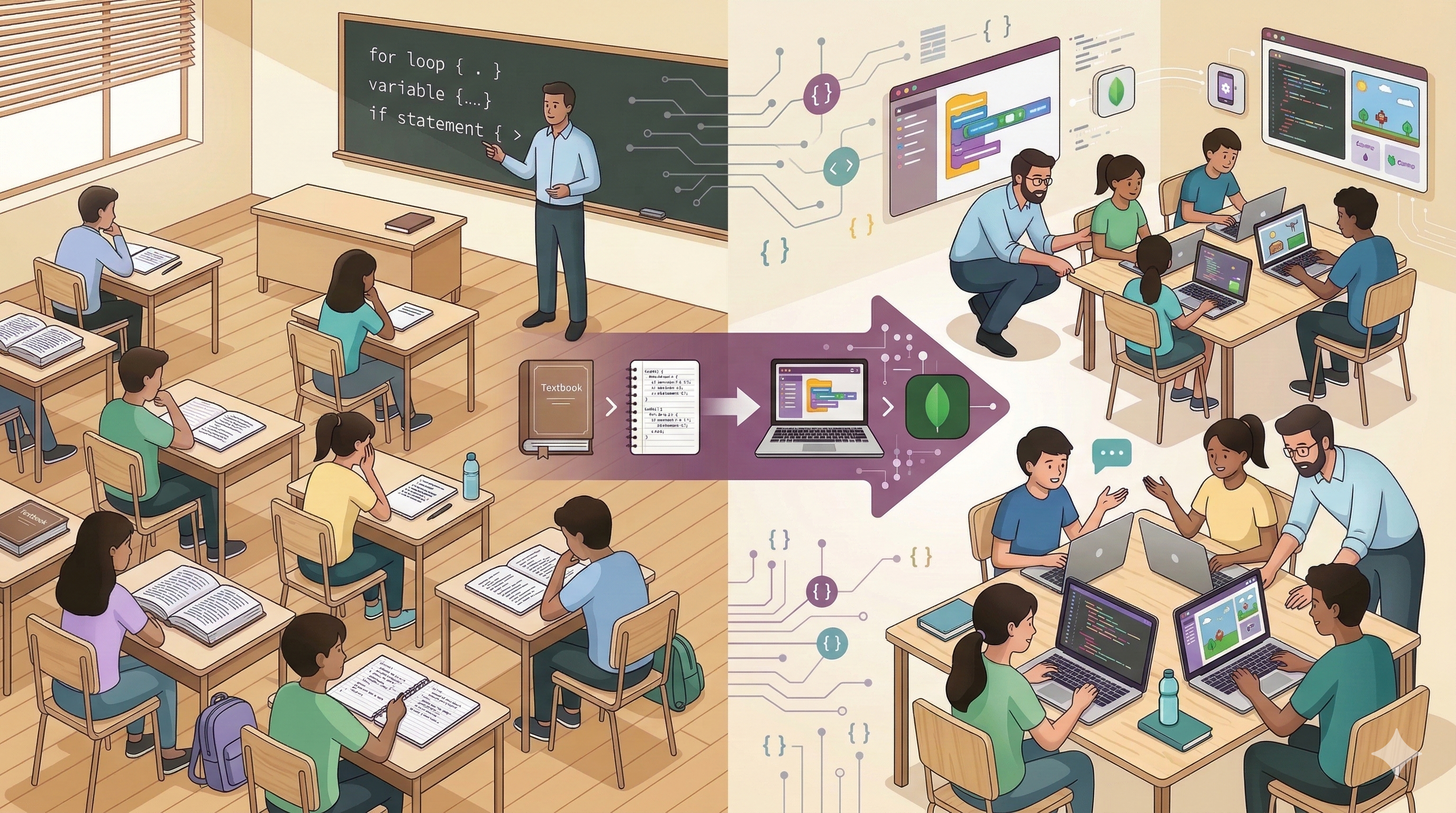
Ask students what they enjoy about technology, and many will say the same thing.
They like building things.
A small game.A simple website.An app that solves a problem.A program that makes something move on the screen.
Yet in many classrooms, coding lessons feel very different.
Students memorise syntax. They copy definitions of programming terms. Sometimes they even write code on paper without running it.
Coding becomes another theory-heavy subject rather than a creative activity.
The irony is clear. Coding itself is not boring.
The way coding is taught often is.
Coding Is a Creative Activity
At its core, programming is a creative discipline.
Developers design systems, experiment with ideas, debug problems, and improve their solutions through iteration.
Learning programming naturally involves:
trial and error experimentation building projects solving problems
Most programmers remember learning best when they were trying to build something they cared about. A simple game, a website, or a personal tool often teaches more than hours of watching tutorials or reading theory.
The excitement comes from creation.
When coding education removes that creative element, engagement drops quickly.
When Coding Becomes Definition-Heavy
In many schools, coding is taught using the same structure as traditional academic subjects.
Lessons often begin with definitions.
What is a variableWhat is a loopWhat is a conditional statement
Students copy examples from the board or textbook.
Assessment then focuses on recalling syntax or explaining concepts rather than applying them.
The result is a learning experience in which students understand individual pieces of information but rarely see how they work together in a real program.
Without building something tangible, coding feels abstract.
Why Classrooms Default to Theory
There are several practical reasons why coding lessons drift toward theory.
Assessment Drives Instruction
If exams ask students to define terms or write code fragments on paper, teachers naturally prepare students for those assessments.
Teaching becomes aligned with what is tested.
Creativity and experimentation are harder to measure in traditional exams.
The “Foundation First” Assumption
Another common belief is that students must first master all programming terminology before building anything.
Teachers may feel that every concept must be explained before students begin experimenting.
But programming does not always work this way.
Many developers learn new tools by starting with a project and discovering concepts along the way.
Classroom Scale
In a typical classroom with 30 students, guiding each student through hands-on programming challenges requires time and structure.
Lecturing definitions can feel more manageable than supervising multiple projects simultaneously.
As a result, the safest path often becomes lecture-based instruction.
Teacher Role Expectations
Traditional teaching models position the teacher as the primary source of knowledge.
In coding education, however, the teacher often works more effectively as a facilitator, guiding students through problem-solving rather than delivering long lectures.
Making this transition requires a shift in classroom culture.
The Difference Between Learning Coding and Doing Coding
Coding is similar to learning a musical instrument.
Reading about music theory does not teach someone how to play the piano.
Practice does.
In programming, understanding concepts such as loops or functions becomes meaningful only when students use them to solve real problems.
Writing a simple game, designing a website, or building a calculator immediately gives context to those concepts.
Without that context, definitions remain disconnected pieces of information.
The Power of Building Projects
When coding education is organised around projects, learning changes dramatically.
Instead of beginning with definitions, students start with a challenge.
For example:
Build a small quiz game. Create a simple website. Design a digital animation.
As students attempt to build these projects, they encounter problems.
How do we repeat an action? How do we store information? How do we respond to user input?
At that moment, concepts like loops, variables, and conditions become meaningful solutions rather than abstract terminology.
Learning becomes contextual.
Introducing Concepts at the Right Moment
One effective approach is sometimes called “just-in-time learning.”
Instead of teaching every concept up front, instructors introduce ideas when students need them.
Students start building something.
When they encounter a limitation, the teacher introduces the relevant concept that addresses it.
This approach keeps theory connected to practical application.
Students see immediately why a concept matters.
Active Learning in Coding Education
Coding education improves significantly when students actively participate in the learning process.
This can include:
Project-based learning: Students build real digital artefacts.
Peer collaborationStudents work in pairs or small teams to solve coding challenges.
Inquiry-driven lessonsClasses begin with a problem rather than a definition.
Gamified challengesProgramming tasks are framed as puzzles or missions.
These methods align with how programmers actually work in real environments.
Moving From Syntax to Problem Solving
Another important shift is focusing less on memorising syntax and more on developing computational thinking.
Students should learn how to:
break problems into stepsdesign logical solutions, test ideas, debug errors
These abilities matter more than remembering specific commands.
Programming languages evolve constantly.
Problem-solving skills remain valuable across technologies.
Coding Education Should Feel Like Creation
When students build things, coding becomes exciting.
They see immediate results.
A button works. A character moves. A website loads.
Each small success reinforces curiosity.
Over time, students gain confidence and develop a deeper understanding of programming concepts.
Coding becomes a tool for expression rather than a subject to memorise.
A Classroom Structure That Supports Building
For project-based coding education to work effectively, classrooms need the right structure.
Students require:
guided activities that build progressivelypractice opportunities during class timeteachers who support experimentationassessment methods that reward creativity and problem solving
When these elements align, coding classes transform from passive learning environments into creative laboratories.
Why This Shift Matters
Technology now shapes nearly every profession.
Understanding programming concepts helps students develop logical thinking and problem-solving skills that extend far beyond software development.
Coding education should not simply teach commands.
It should help students understand how digital systems are designed and built.
When classrooms prioritise building over memorising, coding becomes what it was always meant to be:
a creative way of thinking.
FAQs
Why do many students find coding classes boring?
Coding becomes boring when it is taught primarily through definitions and theory rather than hands-on projects and experimentation.
Is theory important in programming education?
Yes, but theory becomes meaningful when students apply it while building projects. Concepts are easier to understand when they solve real problems.
What is project-based coding education?
Project-based learning allows students to build apps, games, or digital tools while learning programming concepts through practical application.
Do students need to learn syntax first before building projects?
Not always. Many effective learning approaches introduce concepts when students need them during a project.
Why do students learn programming better by building?
Building projects allows students to experiment, debug, and apply ideas immediately, which strengthens understanding and retention.
Call to Action
Coding education becomes meaningful when students move beyond definitions and begin building real solutions.
At Codju, the Accel AI curriculum combines structured lessons with hands-on digital activities through the AI Labs 360 platform, allowing students to practice, experiment, and develop computational thinking within normal classroom time.
To explore how schools are implementing modern coding and AI education in a structured way, visit: