Why Computer Education Still Feels Outdated in Many Schools
Many schools have computer labs and internet access, yet computer education still feels outdated. This article explores the real reason: classroom implementation, theory-heavy learning, and the lack of structured practice in technology education.
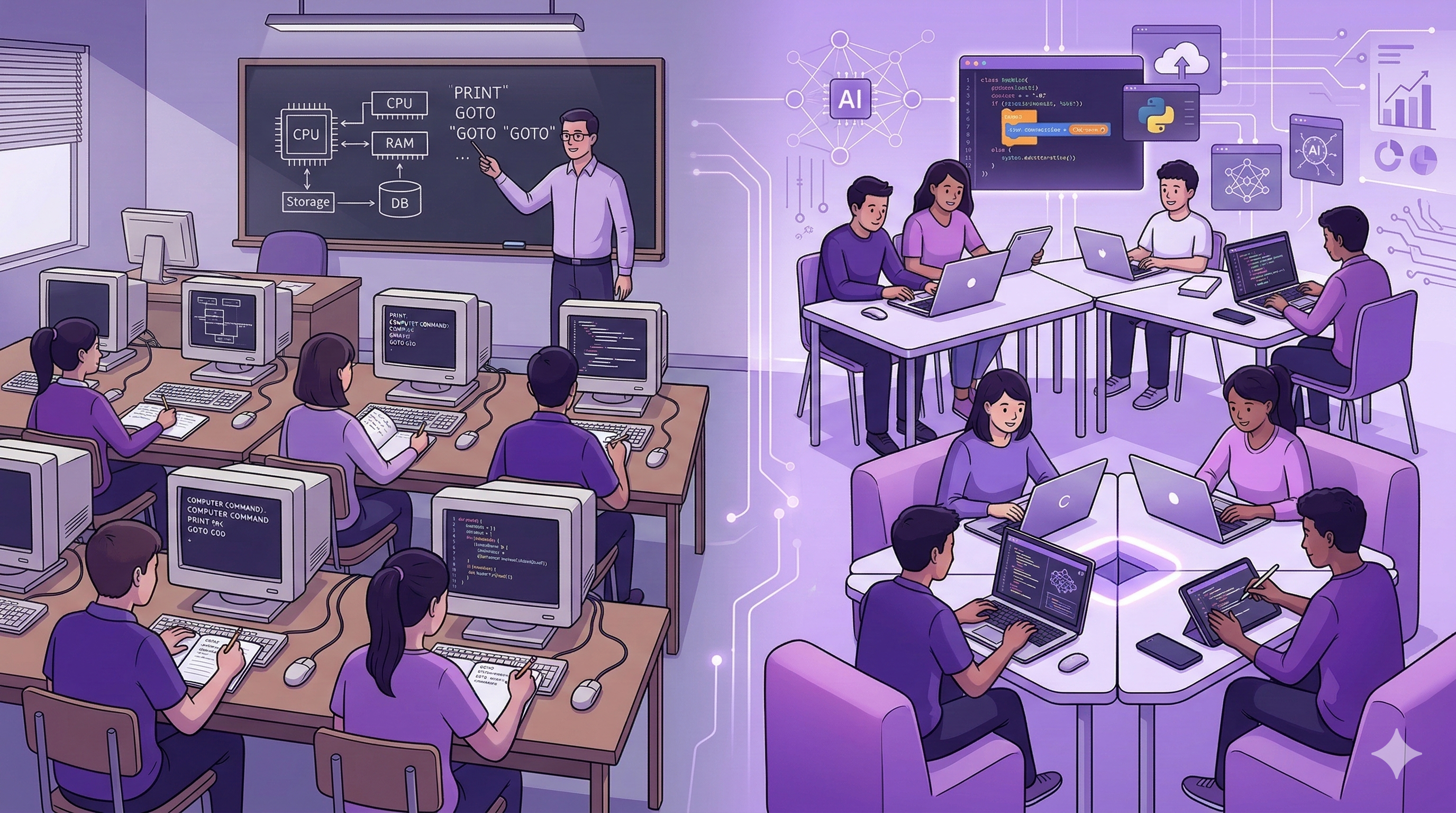
Why Computer Education Still Feels Outdated in Many Schools
Walk into most schools today, and you will see something encouraging.
Computer labs exist. Students have access to devices. Internet connectivity is increasingly common.
Yet a strange contradiction persists.
Despite technological advances, computer education in many schools still feels outdated.
Students often learn definitions of hardware components, memorise steps for using software, or write code on paper. Meanwhile, the digital world outside the classroom is evolving through artificial intelligence, cloud platforms, collaborative software development, and data-driven systems.
The issue is not simply infrastructure.
The real challenge lies in how computer education is structured and implemented inside classrooms.
The Gap Between Modern Technology and Classroom Learning
Modern technology environments are dynamic.
Software is built collaboratively. Problems are solved through experimentation. Learning often happens through projects and iteration.
In contrast, school computer education is frequently organised around a traditional academic structure.
Lessons focus on theory first. Students memorise commands or definitions. Assessment often rewards recall rather than problem-solving.
This creates a disconnect.
Students may use smartphones, apps, and online platforms daily, yet the way computing is taught in school does not always reflect how digital systems actually work.
The result is a learning experience that feels disconnected from reality.
When Computer Education Becomes Memorisation
In many classrooms, computer science is treated similarly to subjects like history or geography.
Students are asked to remember definitions such as:
What is a CPUWhat is a databaseWhat is a computer virus
Sometimes they even memorise step-by-step instructions for using software tools.
But computing is not fundamentally about remembering definitions.
It is about understanding systems and solving problems.
When the focus shifts too heavily toward memorisation, students lose the opportunity to develop computational thinking. That means learning how to break problems into steps, design solutions, test ideas, and improve them through iteration.
Without this mindset, computer education becomes theoretical rather than practical.
The Teacher Enablement Challenge
Another major challenge is teacher preparedness.
Technology evolves quickly. Programming languages change. New tools appear constantly. Artificial intelligence and data systems are transforming industries.
For teachers who were trained years earlier, staying up to date on these developments can be difficult without structured support.
In some schools, computer classes are assigned to teachers whose primary specialisation lies in other subjects. Even when teachers are committed and capable educators, the lack of ongoing training can limit the effectiveness with which modern technology concepts are introduced in the classroom.
This challenge is not about teacher intent.
It is about providing educators with the right frameworks, resources, and support systems.
Curriculum That Moves Slower Than Technology
Technology evolves faster than most school curricula.
A curriculum revision may happen every several years. Technology platforms, on the other hand, can transform within months.
As a result, students sometimes encounter topics that reflect an earlier phase of computing. Examples may include older software interfaces or programming environments that no longer resemble the systems used in modern workplaces.
However, updating content alone does not fully solve the problem.
Even when modern languages such as Python are introduced, the learning approach often remains the same: theory-heavy lessons followed by exams that test syntax rather than application.
The deeper issue is not the topic.
It is the learning structure.
The Assessment Problem
Assessment plays a powerful role in shaping how subjects are taught.
If exams reward memorising definitions, classrooms will emphasise memorisation.
If exams reward writing code on paper, practical experimentation becomes less important.
This misalignment can lead to situations in which students learn programming concepts without ever building meaningful projects or exploring real-world problem-solving scenarios.
Computer science is treated as another exam subject rather than a creative, exploratory discipline.
Why Infrastructure Alone Does Not Solve the Problem
Many education initiatives focus on infrastructure improvements.
More computers, Faster internet, Smart classrooms
These investments are valuable. However, they do not automatically transform learning.
A well-equipped computer lab can still deliver outdated experiences if classroom time is spent primarily on lectures or theoretical explanations.
Technology in education becomes powerful only when it is integrated into the learning process itself.
The real transformation happens when students actively use technology to explore ideas, test solutions, and build projects.
The Need for Structured Practice
What computer education needs most is structured practice.
Students must move beyond simply reading about technology. They should spend time actively working with it.
This can take several forms.
Project-based learningStudents build small applications, games, or digital tools that solve real problems.
Problem-solving exercises. Instead of memorising commands, students design step-by-step solutions.
Collaborative workStudents learn how digital projects are developed in teams.
Exploratory learningStudents experiment with systems, test ideas, and learn from mistakes.
Through these experiences, technology becomes something students interact with rather than something they only study.
From Digital Literacy to Computational Thinking
Earlier generations of computer education focused primarily on digital literacy.
Students learned how to operate a computer, use office software, and navigate files.
Today, digital literacy alone is not enough.
Students need to understand how technology systems function and how problems can be solved through computation.
This includes ideas such as:
AlgorithmsDataNetworksArtificial Intelligence Logical Thinking
These concepts prepare students not only for technology careers but also for a world where technology shapes nearly every profession.
Rethinking Computer Education for the Modern Classroom
Updating computer education requires a shift in perspective.
Instead of asking:
“What software should students learn?”
Schools must ask:
“How should students think about technology?”
Effective technology education combines three elements.
Clear conceptual understandingHands-on practice support
When these elements work together, computer education becomes engaging, relevant, and meaningful.
A Path Forward
The goal of computer education is not to turn every student into a software engineer.
The goal is to help students understand the digital systems that shape modern life.
When students learn how technology works, they become more capable users, more thoughtful creators, and more confident problem solvers.
Achieving this requires thoughtful curriculum design, teacher enablement, and classroom structures that prioritise practice over memorisation.
Schools that successfully make this transition will help students move from simply using technology to understanding it.
FAQs
Why does computer education feel outdated in many schools?
In many cases, the challenge lies in classroom structure rather than infrastructure. Lessons often emphasise theory and memorisation instead of hands-on practice and problem-solving.
Is outdated hardware the main reason computer education struggles?
Not necessarily. Many schools now have computer labs and internet access. The larger issue is how technology is used during classroom learning.
What should modern computer education focus on?
Modern computer education should focus on computational thinking, data awareness, algorithms, cybersecurity, and practical project-based learning.
Why is practical learning important in computer education?
Technology is best understood through experimentation and creation. Building projects helps students develop a deeper understanding than memorising definitions.
Do all students need to learn coding?
Not every student needs to become a programmer. However, understanding how digital systems work is becoming increasingly important across professions.
Call to Action
At Codju, the focus is not only on teaching technology concepts but also on enabling real classroom implementation.
The Accel AI curriculum and AI Labs 360 platform are designed to support structured learning, practice-driven activities, and teacher enablement, enabling technology education to work within normal school hours.
Explore how schools are implementing modern AI and digital skills education through a structured ecosystem.
Visit https://codju.com to learn more.