Why Computer Labs Often Remain Underused
Many schools invest heavily in computer labs, yet these spaces often remain idle. This article explores why infrastructure alone does not create meaningful technology learning and what schools can do to change that.
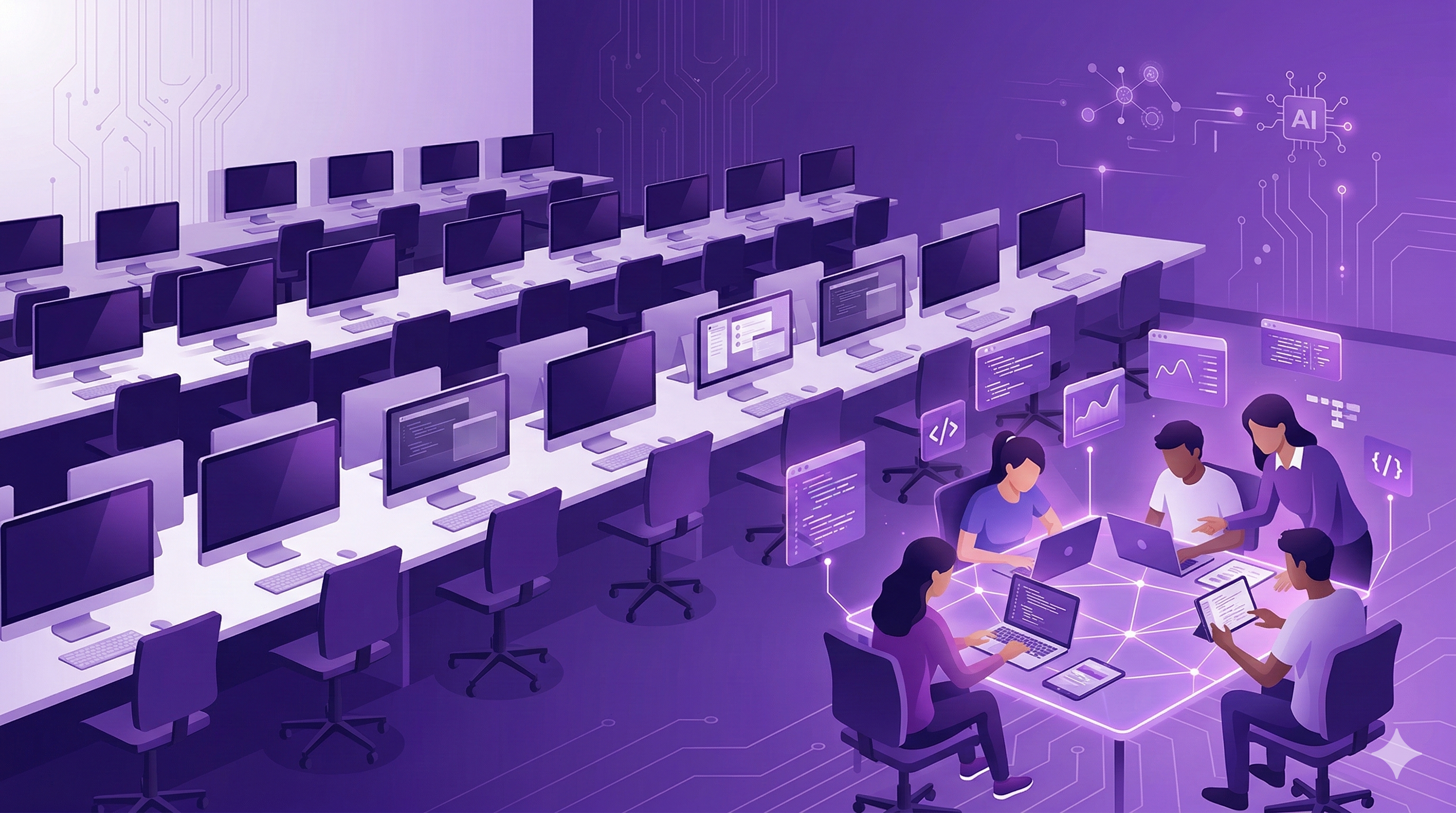
Walk into many schools, and you will find a familiar facility.
A computer lab filled with rows of desktops.Neatly arranged chairs.Network cables running across the room.A sign outside that says “Computer Laboratory.”
From an infrastructure perspective, the school appears ready for digital education.
Yet in many cases, the lab remains surprisingly quiet.
Classes visit occasionally. Students complete a scheduled activity. The room then sits unused for long periods.
This raises an important question.
If the infrastructure exists, why does technology learning still feel limited?
The answer lies in a simple reality.
Infrastructure alone does not create a learning system.
The Early Vision of Computer Labs
When computer labs were first introduced in schools, they represented a major step forward.
They provided access to devices that students did not have at home.
Students could learn:
basic computer operations, processing, presentation tools, internet browsing
At that time, the lab itself was the technology experience.
Students walked into a different environment where computers were available, and learning took place.
However, technology education has changed significantly since then.
Technology Is No Longer a Separate Subject
Today, technology shapes almost every area of life.
Students interact with digital systems daily through smartphones, online platforms, games, and applications.
Technology is no longer limited to a single room in the school.
Yet in many institutions, computer labs still operate under the older model where technology learning is confined to scheduled lab periods.
This structure creates a disconnect.
Instead of integrating technology into everyday classroom learning, schools often treat it as an isolated activity.
The Scheduling Constraint
One of the most common reasons labs remain underused is simple scheduling.
A typical lab can accommodate only one class at a time.
Schools with hundreds or even thousands of students must coordinate limited lab hours across multiple grades and subjects.
As a result:
Classes visit infrequently, sessions become tightly timed, and teachers focus on completing a predefined task
There is little room for experimentation or extended projects.
Technology learning becomes compressed into occasional sessions rather than continuous practice.
Technology Without Classroom Integration
Another challenge is that labs are often physically and academically separate from regular classrooms.
Students leave their classroom, walk to the lab, complete an activity, and then return.
This separation unintentionally sends a message.
Technology becomes something students “visit” rather than something they use regularly.
In modern digital environments, however, technology is integrated into everyday work.
Professionals use digital tools continuously to solve problems, analyse data, and design solutions.
When computer labs remain isolated, students miss that integrated experience.
Teacher Confidence and Enablement
Even when labs are available, effective use depends heavily on teacher readiness.
Technology evolves quickly.
Artificial intelligence, data systems, coding platforms, and digital collaboration tools continue to reshape how technology is used.
Teachers may want to incorporate technology into their lessons, but without structured training or clear classroom frameworks, using the lab effectively can feel uncertain.
In such cases, labs become reserved for predefined lessons rather than flexible spaces for exploration.
The Maintenance Challenge
Maintaining a computer lab requires continuous attention.
Software must be updated. Hardware needs periodic replacement. Network systems must function reliably.
When labs experience slow systems, outdated applications, or broken equipment, teachers may hesitate to rely on them during lessons.
Even small technical issues can disrupt a class schedule.
Over time, these frustrations can reduce the frequency of lab use.
The Shift Toward Personal Devices
In some schools, students increasingly bring their own devices.
Laptops, tablets, and smartphones now provide computing power that once existed only in labs.
This shift creates a new challenge.
If personal devices are available, schools must reconsider how labs fit into the broader technology learning strategy.
Labs can still play an important role, but only when they support structured learning experiences rather than simply providing access to computers.
When Infrastructure Exists but the Learning System Does Not
The core issue is not the presence of computers.
It is the absence of a structured learning system that connects infrastructure, curriculum, and classroom practice.
A meaningful technology learning environment requires several elements working together.
Curriculum that introduces modern digital concepts.
Classroom activities that require students to practice and apply those concepts.
Teacher enablement that provides confidence and guidance.
Assessment structures that value problem-solving and digital thinking.
Without these elements, infrastructure alone cannot create sustained learning.
Reimagining the Role of Computer Labs
Computer labs still play an important role in schools.
They can serve as spaces for:
coding digital projects experimentation analysis activities collaborative problem solving
But this requires a shift in perspective.
The lab should not function as a separate technology room.
It should function as a structured environment where students practice digital thinking.
When learning activities are mapped clearly to classroom objectives, labs become active learning spaces rather than occasional destinations.
From Infrastructure to Learning Ecosystem
The future of technology education is not defined by the number of computers a school owns.
It is defined by how effectively technology learning is structured and implemented.
Schools that succeed in digital education connect several layers:
curriculum design, classroom practice, technology platform, training, student assessment
When these layers align, infrastructure becomes part of a larger learning ecosystem.
Computer labs stop being idle spaces.
They become environments where students explore how digital systems actually work.
A Practical Path Forward
For schools looking to strengthen technology education, the question should not simply be:
“Do we have enough computers?”
The more important question is:
“How are students learning to think with technology?”
When digital learning is integrated into regular classroom practice and supported by structured activities, computer labs become valuable resources rather than underused facilities.
The transformation does not require abandoning existing infrastructure.
It requires connecting that infrastructure to a clear learning system.
FAQs
Why are computer labs often underused in schools?
Computer labs often remain underused because technology learning is treated as a separate activity rather than integrated into everyday classroom learning.
Does having more computers improve technology education?
Not necessarily. Effective technology education requires curriculum design, teacher enablement, and structured learning activities in addition to infrastructure.
Are computer labs still relevant today?
Yes. Computer labs can provide structured environments for coding, digital projects, and AI activities when integrated into a broader learning ecosystem.
Why do teachers sometimes avoid using computer labs?
Technical issues, limited training, and tight scheduling can make it difficult for teachers to integrate labs into regular classroom lessons.
What should modern technology learning environments focus on?
They should focus on computational thinking, problem solving, project-based learning, and practical engagement with digital systems.
Call to Action
Computer labs become powerful learning environments when they are connected to structured classroom practice.
At Codju, the Accel AI curriculum and AI Labs 360 platform are designed to support schools in moving beyond infrastructure toward a complete technology learning ecosystem that includes curriculum, practice, reporting, and teacher enablement.
To explore how schools are implementing modern AI and digital skills education, visit: