In this article
- 01 What Is AI Literacy for Students?
- 02 AI Literacy Is More Than Knowing How to Use ChatGPT
- 03 The 7 Core Things Students Should Learn About AI Before Grade 8
- 04 1. Understand What AI Actually Is (Demystifying the “Magic”)
- 05 2. Learn to Question AI-Generated Information
- 06 3. Understand Hallucinations, Bias, and Misinformation
- 07 4. Teach Privacy Before Convenience
- 08 5. Learn When AI Should (and Should NOT) Be Used
- 09 6. Learn to Ask Better Questions (Prompting as Structured Reasoning)
- 10 7. Keep Human Judgment in the Loop
- 11 AI Literacy vs. Digital Literacy: The Critical Distinctions
- 12 What Should AI Education Look Like in the Classroom? (Grade-by-Grade Progression)
- 13 Classes 3–5 (Preparatory Stage): Discover & Observe
- 14 Classes 6–8 (Middle Stage): Question, Critique & Apply
- 15 A Simple 4-Stage AI Literacy Framework for Schools
- 16 Where Computational Thinking Fits In
- 17 How Codju Technologies Approaches AI Education
- 18 The Goal Is Not “AI-Ready” Students. It Is Capable, Empowered Humans.
- 19 Sources, Frameworks & Further Reading
- 20 Suggested Further Exploration from Codju
Artificial intelligence is no longer an abstract topic reserved for university research labs or corporate boardrooms. It is actively shaping how school students search for information, write assignments, generate artwork, solve mathematics problems, communicate on social platforms, and understand the world around them.
That shift makes AI literacy for students an indispensable pillar of modern school education.
Yet in many schools and parent discussions, AI education is frequently reduced to a single, superficial skill: teaching children how to write prompts into ChatGPT.
That is a dangerous oversimplification.
A student who knows how to prompt a generative model can still accept an entirely fabricated hallucination as factual truth. A student who can generate a digital illustration in seconds can still fundamentally misunderstand how algorithmic models ingest copyrighted training data. And a middle schooler who uses an AI tool responsibly for science research one afternoon may inadvertently paste sensitive personal details into an unvetted chatbot that evening because nobody taught them about data retention, algorithmic bias, or digital footprints.
So what should K–12 schools actually teach before students complete the middle school years?
Authoritative international educational benchmarks provide clear guidance:
- The OECD 2026 AI Literacy Framework defines AI literacy as the holistic combination of knowledge, skills, and attitudes learners require to understand how AI works, critically evaluate AI outputs, and interact with AI ethically and creatively.
- The UNESCO AI Competency Framework for Students positions young learners not merely as passive consumers, but as responsible users and co-creators across four interdisciplinary pillars: human-centred mindset, AI ethics, AI techniques and applications, and AI system design.
- The Stanford Teaching Commons AI Literacy Guide groups generative AI literacy into four interconnected areas: functional literacy (mechanisms and usage), ethical literacy (accuracy, bias, equity, privacy), rhetorical literacy (communication patterns), and pedagogical literacy (how AI impacts learning).
For schools, this consensus points to an unmistakable, overarching imperative:
Students must learn how to understand AI, question AI, use AI responsibly, and make informed decisions when AI is available.
What Is AI Literacy for Students?
AI literacy for students is the ability to understand the fundamental principles behind artificial intelligence, recognize where AI operates in everyday technology, critically evaluate what machine models produce, and employ AI systems in ways that are safe, intellectually honest, ethical, and pedagogically appropriate.
AI literacy is not about training every 12-year-old to code backpropagation algorithms or build neural networks from scratch. It is about instilling a clear, questioning mental model.
An AI-literate student developing healthy cognitive habits gradually learns to ask:
- How does this AI system work? What data was it trained on, and what patterns is it recognizing?
- Where does its information come from? Can I verify this claim against established, primary sources?
- Can this output be mistaken or biased? Does the answer reflect a narrow dataset or historical prejudice?
- What information am I sharing? Does this input expose my identity, location, family, or academic integrity?
- Should I use AI for this specific task? Will using AI deepen my understanding as a thinking partner, or bypass my cognitive struggle as a cheap shortcut?
- How do I maintain my own human agency? Am I directing the machine, or is the machine quietly directing my thoughts?
AI Literacy Is More Than Knowing How to Use ChatGPT
The clearest way to grasp this distinction is to observe two middle school students working on the same classroom assignment.
Knows how to prompt an AI chatbot. Writes: "Give me five reasons why renewable energy adoption is stalling in developing nations."
Copies the bullet points directly into a slide presentation, reformats the fonts, and submits the project. Accepts all generated claims without verification.
Uses AI as a sparring partner. Asks: "Which of these generated claims can be backed by verified economic data, and which are generalizations?"
Cross-references the statistics against national energy reports, spots an outdated metric, refines the line of inquiry, and credits the synthesized insight.
Both students know how to open a browser window and type into an AI interface. Only one is demonstrating AI literacy.
This distinction is vital because generative AI systems produce text and code that are syntactically fluent, grammatically polished, and psychologically convincing—even when they are completely inaccurate. As researchers at Stanford emphasize, educational programs must train students to examine AI’s inherent capabilities and limitations rather than accepting fluent responses as authoritative truth.
That is why teaching AI in schools must never begin and end with prompt templates.
The 7 Core Things Students Should Learn About AI Before Grade 8
7 Essential AI Literacy Pillars Before Grade 8
Data + Models + Pattern Recognition ≠ Magic or conscious minds.
Cross-check assertions, demand verified evidence, audit fluency vs. truth.
Understand training dataset skews, plausibility traps, and synthetic media.
Enforce strict data boundaries: no personal records, photos, or secrets in prompts.
Deepen conceptual exploration rather than skipping the productive struggle.
Apply Computational Thinking (decompose, constrain, iterate) to steer models.
Values, empathy, context, and ultimate accountability must stay with humans.
1. Understand What AI Actually Is (Demystifying the “Magic”)
Before students can evaluate AI, they need a clear, demystified mental model of what AI is—and what it is not.
Middle schoolers do not need calculus or backpropagation mathematics. However, they must understand that AI systems are mathematical and computational structures built by human beings, trained on datasets, and designed to recognize patterns, make predictions, and generate outputs.
They must also distinguish between different varieties of artificial intelligence that they encounter daily:
The core conceptual benchmark for middle school is simple:
A student must recognize that an AI model is an engineered statistical engine trained on historical data—not a conscious mind, and not an infallible source of truth.
2. Learn to Question AI-Generated Information
The ability to critically audit machine-generated assertions is perhaps the single most urgent intellectual defense a young person can acquire.
Students must internalize that an answer delivered with absolute linguistic certainty by a conversational model can still be:
- completely correct,
- subtly incomplete,
- misleadingly out of context,
- culturally or statistically biased,
- factually outdated,
- or entirely fabricated.
Teaching critical questioning does not mean fostering cynical defeatism where students reject all digital information. Rather, it means transforming the learner from a passive consumer into an active evidentiary investigator.
Provide students with three AI-generated answers to a historical or scientific question (e.g., "What caused the decline of the Indus Valley Civilization?"). Instruct student pairs to highlight statements into three distinct categories: Verified by our textbook/encyclopedia (Green), Plausible but requires evidence (Yellow), and Contradictory or ungrounded speculation (Red). This shifts student behavior from accepting output to actively stress-testing claims.
This aligns directly with the OECD 2026 AI Framework, which specifies critical evaluation of algorithmic outputs as a foundational competency for both primary and secondary learners.
3. Understand Hallucinations, Bias, and Misinformation
Before completing Grade 8, students should be fluent in three specific conceptual terms:
A. Hallucination
When an AI system produces statements that sound entirely coherent and authoritative, but are unsupported by real-world facts or data.
Classroom Demonstration: Ask an AI tool: “Summarize the famous 1924 Moon landing expedition led by Professor Higgins.” Observe how smoothly the model fabricates dates, crew members, and scientific achievements for an event that never occurred. Then ask students: “Why did that answer sound so believable?” Analyzing why plausible-sounding language masquerades as truth teaches deeper literacy than memorizing dry definitions.
B. Algorithmic and Dataset Bias
When an AI system produces skewed or unfair predictions because the data it ingested reflects historical inequities, cultural omissions, or sample imbalances.
Classroom Discussion: If a computer vision model is trained primarily on photographs of doctors from one geographic region or gender, it may fail to recognize female doctors or rural practitioners from other cultures. Students must learn that machines inherit the blind spots of their training datasets.
C. Misinformation and Synthetic Media
How synthetic text, deepfake audio, and synthetic imagery can be generated at scale to deceive audiences, manipulate opinions, or erode trust.
As UNESCO highlights in its AI Competency Framework for Students, cultivating ethical discernment and critical skepticism regarding synthetic media is essential for safeguarding democratic participation and academic integrity in an AI-saturated world.
4. Teach Privacy Before Convenience
Students are accustomed to downloading apps, tapping “Agree,” and trading personal information for entertainment. Generative AI introduces an entirely new vector of privacy vulnerability.
Middle schoolers must understand that public AI tools frequently ingest user conversations, queries, and uploaded documents to retrain future iterations of their models.
Before Grade 8, students should understand the risks of sharing:
- Personal identifying information (full legal names, dates of birth, home addresses, phone numbers),
- Passwords and account credentials,
- Personal and family photographs or videos,
- Location data and daily schedules,
- Confidential school records or health details,
- Private peer conversations or interpersonal disagreements.
"Before you paste any text, photo, or question into an AI tool, pause and ask: Would I feel comfortable seeing this projected on the school assembly screen or posted on a public billboard?"
If the answer is no, that data does not belong in the prompt box.
Stanford’s AI literacy guidelines specifically mandate that data privacy must be taught concurrently with functionality, ensuring young learners do not sacrifice digital safety for conversational convenience.
5. Learn When AI Should (and Should NOT) Be Used
This is where the boundary between standard digital skills and true AI literacy becomes sharpest.
Traditional digital literacy asks:
“Can you use this software tool efficiently to complete the task?”
AI literacy asks a fundamentally different, metacognitive question:
“Should you use AI for this task at all?”
Consider a student tackling a challenging algebra concept or struggling through an essay introduction:
- Scenario 1 (Thinking Partner): The student attempts the problem, gets stuck, and prompts the AI: “Can you give me a real-world analogy to help me visualize why we balance both sides of an algebraic equation?” The student reads the explanation, grasps the concept, and works through the math independently.
- Scenario 2 (Cognitive Shortcut): The student takes a photo of the homework worksheet, feeds it into an AI solver, copies down the completed answers, and closes their notebook.
The software tool is identical. The educational outcome is polar opposite.
- Stimulates deeper curiosity: Acts as an interactive tutor asking guiding questions.
- Explains difficult mechanics: Generates relatable analogies for abstract concepts.
- Offers counter-arguments: Helps students pressure-test their own reasoning.
- Strengthens agency: Learner remains in the driver's seat of intellectual discovery.
- Bypasses productive struggle: Copies answers without encoding knowledge into memory.
- Eradicates critical retention: Brain does not build neural pathways for problem-solving.
- Substitutes machine for mind: Student becomes a passive pasteboard operator.
- Builds intellectual helplessness: Inability to reason when technology is inaccessible.
When students outsource cognitive struggle, they rob their developing brains of the synaptic reinforcement required for deep learning. As Google’s AI Literacy initiatives underline, educating students on when to put the tool down is just as critical as showing them how to use it.
6. Learn to Ask Better Questions (Prompting as Structured Reasoning)
Prompt engineering has received immense attention, but in schools, prompting must never be taught as a collection of “magic keyword tricks” or copy-paste recipes.
Meaningful prompting is fundamentally an exercise in structured thinking and clear communication.
Students should learn how iterative instruction changes machine outputs:
- Providing explicit context and role constraints,
- Defining the target audience and tone,
- Requesting step-by-step reasoning or underlying assumptions,
- Demanding multiple alternative perspectives,
- Instructing the AI to critique its own prior response.
Yet underneath prompting lies a deeper, enduring capability: knowing what question is worth asking in the first place.
This directly links AI literacy to Computational Thinking. A student who can decompose a messy problem, identify boundary conditions, detect patterns, and formulate precise instructions is naturally equipped to communicate with AI models far more effectively than a student who relies on memorized prompt cheat sheets.
7. Keep Human Judgment in the Loop
The ultimate capstone of school-level AI literacy is knowing when not to accept the machine’s verdict.
Computation operates on statistical probabilities, but human life operates on:
- Ethical principles,
- Emotional empathy,
- Cultural nuance and local context,
- Moral accountability,
- Real-world consequences.
Imagine an AI system used in a classroom to recommend which student should lead an environmental science group project. The algorithm might rank peers based strictly on past test scores or attendance data. But should that recommendation automatically dictate the leadership choice?
Of course not. A teacher and classmates know qualities no model can calculate: who showed exceptional resilience after a setback, who excels at encouraging quiet peers, and who brings unique creative passion to environmental causes.
Every middle schooler should carry this guiding question into adulthood:
“What can AI assist me with here, and what decision must remain mine alone?”
That question preserves human agency in an automated world.
AI Literacy vs. Digital Literacy: The Critical Distinctions
While AI literacy builds upon the foundation of general digital literacy, the two paradigms address fundamentally different cognitive challenges.
A school that teaches children how to search on Google or create a presentation in Canva, but never teaches them how to interrogate an AI-generated paragraph, is delivering an increasingly incomplete education for the decade ahead.
What Should AI Education Look Like in the Classroom? (Grade-by-Grade Progression)
Age-appropriate AI education must match the cognitive development of the student, evolving systematically from sensory exploration to ethical analysis.
Classes 3–5 (Preparatory Stage): Discover & Observe
At this stage, learning should be experiential, playful, and largely unplugged or low-code:
- Observation: Where is AI at work around us? (Smart speakers, photo sorting, autocorrect).
- Pattern Matching: How do computers group objects by color, shape, and sound?
- Data Awareness: What is data? How does a machine learn what an apple looks like?
- Fallibility: Can a computer be tricked by a blurry image or a strange voice?
- Foundational Safety: Why we never share our passwords, real names, or home address with any app.
Classes 6–8 (Middle Stage): Question, Critique & Apply
Middle schoolers possess the logical maturity to explore abstract mechanisms and ethical trade-offs:
- Mechanisms: Training data, weightings, tokens, and probabilistic prediction.
- Generative Tools: Using conversational and creative tools with explicit constraints and goals.
- Evidentiary Auditing: Fact-checking generated outputs against authoritative reference libraries.
- Ethics & Bias: Investigating why certain groups are underrepresented or stereotyped in AI models.
- Computational Inquiry: Decomposing complex questions into logical prompt sequences.
- Collaborative Creation: Combining human storytelling with AI-assisted visualization.
This progressive continuum mirrors the mandates of India’s National Education Policy (NEP 2020) and the NCF 2023 Guidelines, which urge schools to transition from rote software learning toward applied, competency-based computational thinking.
A Simple 4-Stage AI Literacy Framework for Schools
Schools do not need a 400-page curriculum to begin. Every classroom lesson involving AI can be anchored in four intuitive questions:
Demystify the underlying mechanism. Identify the inputs, training data source, and computational task.
Stress-test the factual claims. Check for hallucinations, implicit bias, missing perspectives, and safety concerns.
Frame precise inquiries, explore counter-arguments, and ensure the tool accelerates learning rather than replacing effort.
Combine human creativity, judgment, and ethical values with AI capabilities to solve meaningful real-world challenges.
This 4-stage scaffold prevents the most frequent error schools make: introducing high-powered generative tools before students have established the critical reasoning skills needed to govern them.
Where Computational Thinking Fits In
AI literacy and Computational Thinking (CT) must never be treated as isolated classroom subjects.
Computational Thinking provides the intellectual bedrock for understanding how any algorithmic system functions. In Codju’s pedagogical framework, problem-solving follows a structured five-stage journey:
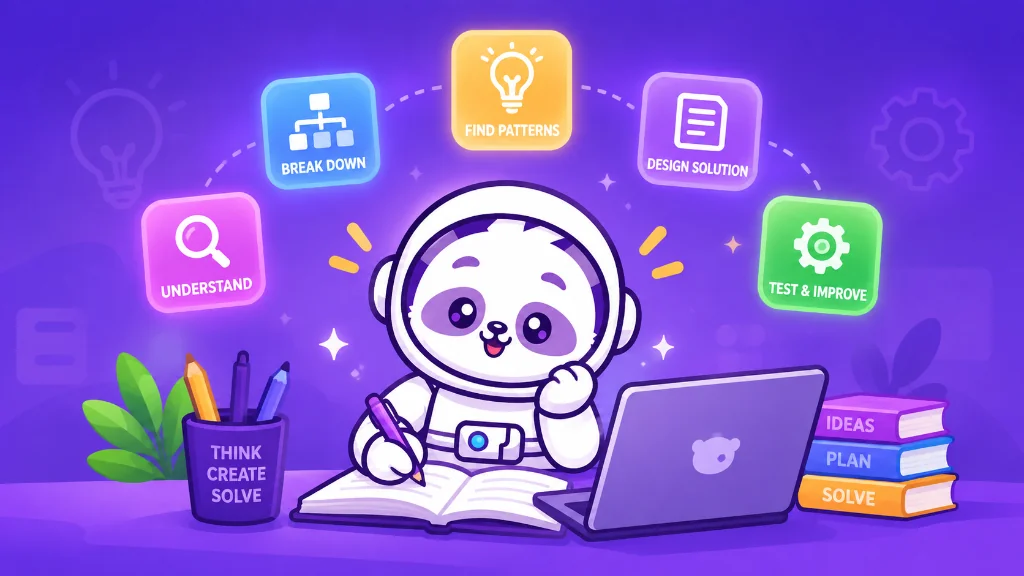
$$\text{Observe} \longrightarrow \text{Break Down} \longrightarrow \text{Find Patterns} \longrightarrow \text{Design Solution} \longrightarrow \text{Test & Improve}$$
Before a student ever prompts an AI model to tackle a complex challenge, they should apply this computational loop:
When taught this way, artificial intelligence ceases to be a magical oracle. It becomes one computational tool within an organized human problem-solving workflow.
How Codju Technologies Approaches AI Education
Codju Technologies is an Indian K–12 AI, ICT, and Robotics EdTech enterprise serving Grades 1 through 10. Codju’s mission is clear and ambitious: to empower 2 million Indian students with foundational AI, Coding, and Digital Skills by 2030.
To help schools transition from outdated computer lab drills to dynamic, future-ready learning environments, Codju integrates two core solutions:
- Accel AI Curriculum: A comprehensive textbook and workbook series for Grades 1 to 8, fully aligned with NEP 2020, NCF 2023, and CBSE’s Computational Thinking guidelines. The curriculum covers what AI is, how data powers algorithms, ethics, machine learning concepts, and cross-disciplinary applications.
- AI Labs 360°: An interactive digital activity and gamified learning platform that lets students experiment with no-code AI models, practice logical reasoning, and build real-world projects in safe, moderated sandbox environments.
- Teacher Capacity Building: Through specialized teacher empowerment programs and initiatives like TeachBoost, Codju trains classroom educators—including those without prior computer science backgrounds—to confidently lead AI discussions, unplugged activities, and ethical debates.
This integrated approach embodies a foundational pedagogical philosophy:
Students should not merely learn how to use AI. They must learn how to think when AI is universally accessible.
For school principals, academic coordinators, and parents evaluating education partners in 2026, that philosophical distinction makes all the difference.
The Goal Is Not “AI-Ready” Students. It Is Capable, Empowered Humans.
Artificial intelligence software will continue to evolve at breakneck speed. The specific chatbot, image generator, or coding assistant that dominates student conversation today will likely be obsolete by the time a current 6th-grader enters college.
Building an education around ephemeral tools is inherently fragile.
A truly durable education focuses on the cognitive competencies that outlast any technological cycle:
- Conceptual understanding over mechanical tool tricks,
- Critical skepticism over passive acceptance,
- Evidentiary verification over blind trust,
- Ethical responsibility over thoughtless convenience,
- Human empathy and agency over algorithmic dependence.
Schools do not need to predict every AI application of 2035. They simply need to equip students with enough foundational knowledge, curiosity, and ethical fortitude to navigate unfamiliar systems wisely.
And before any student finishes Grade 8, they should reflexively ask the most important question of the AI era:
“The AI gave me an answer. How do I know it is right?”
That single question is a far more powerful beginning for AI education than asking:
“What prompt should I copy?”
Sources, Frameworks & Further Reading
To support academic coordinators, curriculum designers, and educators seeking high-authority documentation, review these primary foundational resources:
- OECD / European Commission — Empowering Learners for the Age of AI (2026): Comprehensive international framework addressing AI literacy, pedagogical competencies, and student agency across primary and secondary education systems.
- UNESCO — AI Competency Framework for Students: Global educational guidelines establishing 12 core student competencies spanning human-centred mindsets, AI ethics, techniques, and design.
- Stanford Teaching Commons — Understanding AI Literacy: Pedagogical research framework detailing functional, ethical, rhetorical, and pedagogical literacies in education.
- Google AI — Build AI Knowledge and Literacy: Practical resources and learning modules developed for students, educators, and families focused on safe, effective, and responsible AI usage.
- National Education Policy 2020 (NEP 2020) — Ministry of Education, Govt. of India: Foundational policy document mandating the integration of computational thinking, digital literacy, and emerging technologies into Indian school curricula.
- National Curriculum Framework for School Education (NCF 2023): The institutional curriculum architecture outlining competency-based learning and computational problem-solving for Indian schools.
- Google Search Central — Creating Helpful, People-First Content: Industry standard guidelines on producing useful, reader-first educational content with rigorous evidence and original value.
Suggested Further Exploration from Codju
- What Is Computational Thinking? Complete Guide for Students & Schools
- CBSE Computational Thinking for Classes 3–8: Complete Roadmap
- Best AI Tools for Students: A Grade-Wise Guide (2026)
- How Schools Can Evaluate AI Education Partners in 2026
- Explore Codju’s K–10 AI Curriculum & Books
- Book a Demo for Your School
FAQ
Frequently Asked Questions
What is AI literacy for school students?
AI literacy for students is the ability to understand how artificial intelligence works conceptually, recognize where it operates in everyday digital tools, critically evaluate AI outputs for accuracy and bias, and use AI systems safely, ethically, and purposefully without abdicating human judgment.
Why is Grade 8 the critical milestone for foundational AI literacy?
Middle school (Ages 10–14 / Classes 6–8) represents a pivotal cognitive developmental window where students transition from concrete observation to abstract, logical reasoning. Establishing foundational AI literacy before Grade 8 equips students with healthy skepticism and ethical frameworks before unmonitored independent AI use becomes widespread in high school.
How is AI literacy different from knowing how to use ChatGPT?
Knowing how to prompt ChatGPT is merely a superficial operational skill. Genuine AI literacy involves understanding where models retrieve and process data, knowing that large language models hallucinate plausible untruths, questioning inherent dataset bias, protecting personal privacy, and knowing when not to use AI so students do not short-circuit their own cognitive development.
What is the difference between digital literacy and AI literacy?
Digital literacy teaches students how to use hardware, search the web, and create digital media. AI literacy builds upon this foundation by asking whether generated content is authentic, how machine models make statistical predictions, what hidden biases exist in training datasets, and how learners maintain human agency when collaborating with autonomous systems.
What are the 7 essential AI concepts students should learn before Grade 8?
Before Grade 8, every student should master: (1) what AI actually is (probabilistic models trained on data, not conscious magic), (2) how to question AI-generated outputs, (3) hallucinations, bias, and misinformation, (4) data privacy before convenience, (5) when AI should and should not be used (shortcut vs thinking partner), (6) how to ask better questions through Computational Thinking, and (7) keeping human judgment in the loop.
How does Computational Thinking connect with AI literacy?
Computational Thinking provides the analytical scaffold for AI literacy. Through its four pillars—decomposition, pattern recognition, abstraction, and algorithmic design—students learn how machines process data and solve problems systematically, enabling them to evaluate, critique, and co-create with AI rather than remaining passive consumers.
Can schools teach AI literacy without expensive computers or high-tech labs?
Yes. Foundational AI literacy is conceptual and ethical rather than hardware-dependent. Many of the most effective lessons are unplugged and discussion-based: analyzing dataset skews, interrogating fictional hallucinations, role-playing privacy dilemmas, and comparing AI recommendations with human context require zero specialized computing equipment.
How does Codju Technologies support schools implementing AI literacy?
Codju provides the Accel AI curriculum (Grades 1–8 textbooks and workbooks) integrated with AI Labs 360° (an interactive digital activity platform) and teacher enablement workshops. The curriculum aligns with NEP 2020, NCF 2023, and CBSE guidelines to build conceptual AI literacy and Computational Thinking across Indian schools.
Continue Reading
All AI in Education articles →
CBSE Computational Thinking Classes 3–8: What Students Learn at Each Stage
Understand the CBSE Computational Thinking and AI curriculum for Classes 3–8 in 2026–27, including class-wise CT skills, AI concepts, activities, projects, assessment and learning outcomes.
What Is Computational Thinking? Complete Guide for Students & Schools
What is Computational Thinking? Learn the four pillars, real-world examples, CT vs coding, classroom activities, AI connections, and how schools can teach computational thinking.
How Schools Can Start Teaching AI by First Teaching Computational Thinking
Before students can understand AI, they need to understand how thinking works. Learn why computational thinking is the essential bridge to AI literacy.
Why Computational Thinking Matters More Than Coding in School Education
Coding is not the real skill. Thinking is. Discover why computational thinking is the foundation that actually matters for future-ready education.
Codju for Schools