In this article
- 01 What is Computational Thinking?
- 02 Computational Thinking in Simple Words
- 03 1. Break the problem into smaller parts:
- 04 2. Look for patterns:
- 05 3. Decide what information actually matters (Abstraction):
- 06 4. Create a sequence of steps (Algorithm):
- 07 The Four Pillars of Computational Thinking
- 08 1. Decomposition: Breaking a Big Problem Into Smaller Problems
- 09 2. Pattern Recognition: Finding What Repeats
- 10 3. Abstraction: Focusing on What Actually Matters
- 11 4. Algorithmic Thinking: Designing a Step-by-Step Solution
- 12 Are These Really Four “Steps” of Computational Thinking?
- 13 The 5-Stage Framework Codju Uses in Classrooms
- 14 Computational Thinking vs Coding: The Decisive Difference
- 15 Can You Learn Computational Thinking Without a Computer?
- 16 Cross-Disciplinary Computational Thinking
- 17 Computational Thinking and Artificial Intelligence
- 18 Summary Comparison
- 19 How Codju Helps Schools Implement Computational Thinking
- 20 References & Authoritative Reading
When people hear Computational Thinking, they often assume it means coding.
That is understandable. The word computational sounds like computers, programming languages, syntax, and software.
But Computational Thinking starts much earlier than code.
A student deciding how to organize a complicated school science project, a teacher breaking a difficult concept into smaller parts, a scientist looking for patterns in climate data, or an architect designing an energy-efficient building can all use Computational Thinking.
At its simplest, Computational Thinking is a way of approaching problems so that they can be understood, broken down, represented clearly, solved systematically, and improved when necessary.
It draws on ideas from computer science, but the thinking itself is not limited to computers. Jeannette Wing’s landmark 2006 paper helped establish Computational Thinking as a foundational problem-solving approach involving concepts such as abstraction and decomposition, describing it as formulating problems and solutions in a form that can be carried out by a human, a machine, or both.
This distinction matters more than ever in schools today.
The Central Board of Secondary Education has released a dedicated CBSE Computational Thinking and Artificial Intelligence (CT&AI) curriculum for Classes III–VIII for 2026–27, complete with student workbooks and teacher handbooks for each grade.
So what exactly is Computational Thinking? What are its four pillars? Is it the same as coding? How can students learn it without programming? And why is it becoming the cornerstone of 21st-century school education?
Let’s break it down.
What is Computational Thinking?
Computational Thinking is a problem-solving approach that uses concepts and methods associated with computer science to understand problems, design solutions, and express those solutions in a clear, systematic way.
The important part is not the computer.
The important part is the thinking process.
"This problem is huge and complicated. I have no idea where to even start."
"What exactly is the goal? What parts does it contain? What patterns exist, what details matter, and what steps will solve it?"
That way of thinking can be used whether the final solution is carried out by:
- a student,
- a teacher,
- a team,
- a computer,
- an AI system,
- or a combination of people and technology.
The National Curriculum Framework for School Education (NCF 2023) explicitly includes computational thinking as a core competency. It describes students developing the ability to deal with complex problems, break them into simpler components, analyze sequences of instructions, identify similarities across problems, and engage in algorithmic problem-solving.
This is why Computational Thinking should never be reduced to “learning to code.”
Coding can be an application of Computational Thinking. Computational Thinking is the reasoning that comes before and beyond the code.
Computational Thinking in Simple Words
Imagine that your school principal says:
“Organize a school science exhibition for 500 students.”
That sounds like one massive, stressful problem.
You could immediately start scrambling to make a timetable.
Or you could think computationally.
1. Break the problem into smaller parts:
- Which classes are participating?
- How many projects are there?
- Which rooms and lab spaces are required?
- How will student groups be formed?
- How will visitors and parents move through the corridors?
- How will projects be evaluated?
- What electrical equipment is needed?
- What happens if two groups need the same room or power outlet?
2. Look for patterns:
- Every science class needs similar safety measures and display boards.
- Physics and Robotics projects require power outlets, while Biology displays need water access.
3. Decide what information actually matters (Abstraction):
- You probably don’t need to know every student’s favourite colour or lunch preference to design the exhibition layout.
4. Create a sequence of steps (Algorithm):
- Collect project registration data.
- Categorize projects by domain and resource needs.
- Allocate rooms and lab tables.
- Assign time slots.
- Check for scheduling and room conflicts.
- Publish the final schedule.
- Run a dry run test.
- Fix any identified bottlenecks.
You have just used Computational Thinking. No computer or programming language was required.
The Four Pillars of Computational Thinking
There are different ways researchers and educators describe Computational Thinking. However, four concepts are universally recognized in international standards, including the ISTE Computational Thinking Standards:
- Decomposition
- Pattern Recognition
- Abstraction
- Algorithms / Algorithmic Thinking
These are better understood as interconnected thinking skills, not four rigid steps that must always happen in a strict lockstep order.
1. Decomposition
Breaking down a large, complicated problem into smaller, manageable chunks that are easier to understand and solve.
2. Pattern Recognition
Spotting similarities, shared characteristics, trends, or repetitions across different problems to reuse proven solutions.
3. Abstraction
Focusing on the essential details that directly impact the solution, while ignoring irrelevant noise and background data.
4. Algorithmic Thinking
Designing a step-by-step ordered set of instructions or clear logical rules to solve the problem systematically.
1. Decomposition: Breaking a Big Problem Into Smaller Problems
Decomposition means taking a complex problem and dividing it into smaller, more manageable sub-tasks.
Think about planning a school trip. “Plan the annual school trip” is an overwhelming task.
You can decompose it into:
- Selecting the educational destination
- Estimating student headcount
- Calculating the per-student budget
- Arranging bus transportation
- Collecting parent permission slips
- Planning meals and hydration
- Creating student teacher-led groups
- Formulating medical and emergency protocols
- Scheduling itinerary timelines
Each smaller sub-problem is clear and actionable.
A classroom example
Suppose a Class 5 student has to create a presentation about environmental pollution. Instead of staring at a blank slide deck, the student breaks it down:
- Definition: What is pollution?
- Classification: Air, water, soil, and noise pollution.
- Causes: What generates each type?
- Impact: How does it harm living organisms?
- Action Plan: What mitigation steps can communities take?
- Design: How should visuals and bullet points be sequenced?
Without decomposition, students can struggle with complex tasks because they try to solve everything at once. Decomposition teaches them to ask:
“What smaller problems are hiding inside this bigger problem?“
2. Pattern Recognition: Finding What Repeats
Once a problem is decomposed, the next question is:
“Have I seen something like this before?”
Pattern recognition means identifying similarities, repetitions, relationships, or trends.
For example, a student tracking bus arrival times notices:
- Monday: 15 min delay (heavy rain)
- Tuesday: On time
- Wednesday: 20 min delay (heavy rain)
- Thursday: On time
- Friday: 25 min delay (heavy rain + weekend traffic)
The pattern immediately points to weather and peak hours as root causes.
In mathematics, a student solving algebraic equations recognizes that different word problems share identical linear structures. Pattern recognition allows learners to transfer proven models rather than reinventing the wheel every time.
3. Abstraction: Focusing on What Actually Matters
Abstraction is often the most misunderstood of the four ideas. A simple way to understand it is:
Abstraction means deciding which details matter for the problem and which details can be safely ignored.
Consider a subway or GPS navigation map.
A physical city contains millions of details: trees, lamp posts, building heights, colour of shop shutters, and sewer covers. But when you open Google Maps to navigate from home to school, you don’t want to see every individual tree.
You only need:
- Road networks and street names
- Your current location
- Destination point
- Turn-by-turn directions
- Real-time traffic congestion
The map is useful precisely because it filters out what doesn’t matter. That is abstraction.
In the classroom, when Class 7 students create a timetable, they separate:
- Crucial data: Teacher subject specialties, period durations, available rooms.
- Irrelevant data: What colour backpack each student wears, or what the teacher had for breakfast.
4. Algorithmic Thinking: Designing a Step-by-Step Solution
An algorithm is an ordered, unambiguous sequence of instructions used to solve a problem or accomplish a task.
You already follow algorithms every day. Making a cup of tea, tying shoelaces, or checking in for an exam all involve step-by-step algorithms.
The “Robot Teacher” Exercise
Ask a classroom of students:
“Explain how to make a peanut butter sandwich to a robot that takes instructions literally.”
A student will inevitably say: “Put the peanut butter on the bread.” The teacher (acting as the robot) takes the unopened jar of peanut butter and physically places the jar on top of the loaf of bread.
The class laughs, but the lesson hits home: Humans naturally fill in missing context. Computers and algorithms do not. This forces students to understand order, precision, conditional branches, and logical loops.
Are These Really Four “Steps” of Computational Thinking?
This is a critical distinction. Many articles describe the four pillars as rigid sequential “stages”.
Decomposition, pattern recognition, abstraction, and algorithms are core cognitive techniques, not a one-way conveyor belt.
In real-world problem-solving, students move iteratively between them:
- You might spot a pattern before fully breaking down a problem.
- Testing an algorithm might reveal that your abstraction ignored a vital detail, forcing you to revisit your model.
- You might decompose a sub-problem further after noticing an edge case.
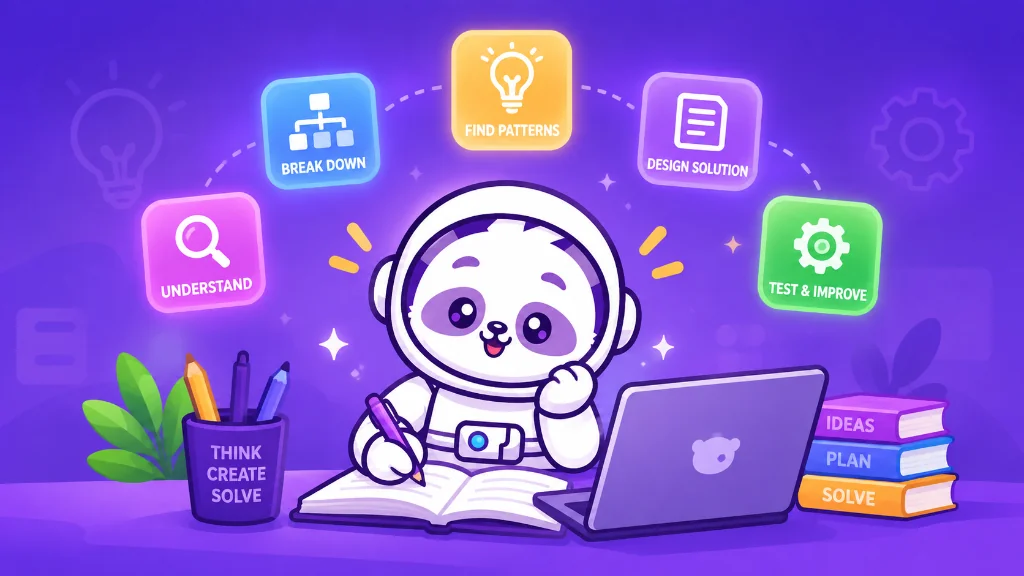
A practical mental model is: Observe → Break Down → Find Patterns → Decide What Matters → Design Solution → Test → Iterate
The 5-Stage Framework Codju Uses in Classrooms
At Codju, we translate these core computer science concepts into a child-friendly, teacher-ready classroom framework:
This 5-stage framework bridges the gap between academic theory and practical 40-minute school periods. It guides students not just to produce an answer, but to embrace testing and iterative debugging as natural parts of learning.
👉 Read our in-depth exploration: How Schools Can Start Teaching AI by First Teaching Computational Thinking
Computational Thinking vs Coding: The Decisive Difference
This is the single most common confusion among educators and school leaders.
💻 Coding (The Implementation Tool)
- Writing instructions in a specific programming language (Python, Scratch, JS)
- Platform and syntax dependent
- Subject to rapid obsolescence as AI code generators evolve
- Focuses on syntax and execution
🧠 Computational Thinking (The Core Skill)
- Designing the logical framework and solution strategy
- Universal and language-independent
- Permanent cognitive capability that transfers across all professions
- Focuses on reasoning and problem formulation
Consider a robot navigating an obstacle maze:
- Determining the coordinates, identifying obstacles, deciding how dead ends are handled, and optimizing the shortest path is Computational Thinking.
- Translating that strategy into Python syntax or Scratch drag-and-drop blocks is coding.
You can be an exceptional computational thinker without knowing Python. Conversely, memorizing coding syntax without understanding computational logic produces students who get stuck the moment a problem differs from the textbook example.
👉 Deep dive: Why Computational Thinking Matters More Than Coding in School Education
Can You Learn Computational Thinking Without a Computer?
Yes — absolutely.
Foundational Computational Thinking should begin unplugged. Screen-free CT activities remove the barrier of computer lab availability, screen fatigue, and software glitches.
- The Human Robot: Students pair up. One acts as the blindfolded "robot," while the other writes precise directional command cards (Turn 90° Right, Step Forward 2). If an instruction is missing, the robot bumps into a desk — demonstrating sequencing and debugging.
- Sorting Networks: Students are given physical cards and must arrange themselves in order by creating comparison rules (sorting by height, birth month, or alphabetical order).
- The Broken Recipe: Present recipe steps scrambled out of order. Students must identify logical dependencies (e.g., you cannot frost a cake before baking it).
- School Event Decomposition: Groups design a Sports Day logistics flowchart, mapping dependencies between referee allocations, track availability, and water stations.
👉 Discover more unplugged strategies: Screen-Free Learning: How to Teach Computational Thinking Without Computers and 5 Classroom Activities to Teach Computational Thinking (No Coding Required)
Cross-Disciplinary Computational Thinking
Computational Thinking does not belong exclusively to the computer science department. It is an interdisciplinary mindset:
- Mathematics: Decomposing multi-step geometric proofs, spotting algebraic sequences, and modeling functions.
- Science: Designing controlled laboratory procedures, analyzing climate data patterns, and categorizing biological specimens.
- Languages: Breaking down sentence grammatical structures, identifying narrative plot patterns, and constructing dialogue decision trees.
- Social Sciences: Analyzing demographic trends, mapping cause-and-effect historical chronologies, and modeling trade networks.
- Art & Design: Breaking complex drawings into geometric primitives, repeating textile motifs, and developing printmaking algorithms.
Computational Thinking and Artificial Intelligence
The explosion of generative AI makes Computational Thinking more vital, not less.
When AI can draft code and write essays in seconds, the critical human question shifts from:
“How do I type this out?”
to:
“What problem am I trying to solve, is this AI-generated solution mathematically and logically sound, and where are its biases?”
An AI prompt user who lacks computational thinking blindly copies output. A computational thinker questions:
- What training data patterns produced this response?
- Does the algorithm handle edge cases?
- How can we decompose the problem into multi-turn chain-of-thought prompts?
This is why CBSE’s integrated CT & AI curriculum couples the two disciplines together for Classes 3 through 8.
👉 Learn what CBSE expects: CBSE Computational Thinking Curriculum 2026: What Schools Must Do
Summary Comparison
| Concept | What It Truly Means | Primary Classroom Goal |
|---|---|---|
| Computational Thinking | A structured approach to problem-solving using computer science reasoning | Teaching students how to think, decompose, and formulate logic |
| Coding | Expressing instructions in a programming language | Translating logic into machine-executable syntax |
| Computer Science | Academic discipline covering computation, algorithms, data systems, and hardware | Understanding how digital computational systems operate |
| Artificial Intelligence | Computational systems capable of perception, pattern recognition, and prediction | Creating and evaluating adaptive intelligent systems |
How Codju Helps Schools Implement Computational Thinking
Schools across India often struggle to implement CT because existing textbooks remain trapped in syntax drills (MS Paint, basic Word, and memorizing HTML tags).
Codju’s complete classroom implementation system changes that:
- Curriculum Aligned with NEP 2020 & CBSE: Progressive Grade 1–10 textbooks focused on the 5-stage CT framework.
- AI Labs 360° Platform: Interactive, browser-based practice labs that teach logic before syntax.
- TeachBoost Training: Teacher guides and hands-on professional workshops so educators of any background can lead engaging CT classes.
👉 Read our comprehensive institutional blueprint: How Schools Can Implement Computational Thinking & AI: A 7-Step Framework
👉 Explore the complete school curriculum: Codju Computational Thinking & AI Platform
👉 Learn about our print books: Accel AI Books for Grades 1–10
References & Authoritative Reading
- CBSE Academic: Computational Thinking & AI Curriculum Guidelines (Classes III–VIII)
- Ministry of Education, India: National Curriculum Framework for School Education (NCF 2023)
- International Society for Technology in Education: ISTE Standards for Computational Thinking
- Communications of the ACM: Jeannette M. Wing, “Computational Thinking” (2006)
FAQ
Frequently Asked Questions
What is Computational Thinking?
Computational Thinking is a problem-solving approach based on concepts and methods associated with computer science. It helps people understand complex problems, break them into manageable sub-problems, identify recurring patterns, filter out irrelevant details, design step-by-step algorithms, and evaluate and improve solutions.
Is Computational Thinking the same as coding?
No. Coding means writing instructions using a programming language or software tool. Computational Thinking is the broader cognitive reasoning process used to formulate and design solutions before any line of code is written. Coding is simply one execution medium for Computational Thinking.
What are the four pillars of Computational Thinking?
The four core pillars of Computational Thinking are Decomposition (breaking problems down), Pattern Recognition (spotting trends and similarities), Abstraction (focusing on what matters while filtering noise), and Algorithmic Thinking (designing step-by-step procedures).
What is decomposition in Computational Thinking?
Decomposition is the practice of taking a large, intimidating problem and dividing it into smaller, self-contained, and manageable sub-problems that can be analyzed and solved independently.
What is pattern recognition?
Pattern recognition means identifying repetitions, shared characteristics, or trends across problems, enabling learners to transfer and reuse previously proven strategies.
What is abstraction in Computational Thinking?
Abstraction is the art of identifying and isolating the critical variables necessary to solve a problem while deliberately filtering out non-essential background details.
What is an algorithm in Computational Thinking?
An algorithm is an ordered, unambiguous sequence of logical steps or rules designed to accomplish a specific outcome or solve a problem.
What are the five stages Codju uses to teach Computational Thinking?
Codju structures classroom learning around a continuous 5-stage framework: Observe (analyze context) → Break Down (decompose) → Find Patterns (recognize similarities) → Design Solution (algorithm & abstraction) → Test & Improve (iterative debugging).
Can Computational Thinking be taught without computers?
Yes. Foundational Computational Thinking can be taught completely screen-free using unplugged activities, sorting challenges, logic puzzles, sequencing games, and structured classroom scenarios without requiring devices or computer labs.
Is Computational Thinking only useful for computer science?
No. Computational Thinking is a universal, cross-disciplinary reasoning habit that strengthens problem-solving across Mathematics, Science, Languages, Social Sciences, Art, and daily operational planning.
Why is Computational Thinking important for students?
It gives students a structured heuristic when encountering unfamiliar challenges. Instead of giving up or guessing, students learn to deconstruct problems, evaluate what matters, and build logical solutions step by step.
Why is Computational Thinking important for AI education?
Modern Artificial Intelligence models operate on data representation, pattern recognition, algorithmic weights, and statistical evaluation. Computational Thinking gives students the cognitive foundation to understand how AI works and critically assess its outputs.
What is the CBSE curriculum mandate for Computational Thinking?
CBSE has introduced a dedicated Computational Thinking and Artificial Intelligence (CT&AI) curriculum for Classes III–VIII for the 2026–27 session, moving Indian classrooms away from rote software memorization toward structured, competency-based logical reasoning.
Does every student need to learn programming?
No. While every child benefits from developing computational reasoning, not every child will become a software engineer. The primary educational objective is nurturing agile, analytical problem-solvers across every profession.
What is the difference between Computational Thinking and Computer Science?
Computational Thinking is a thought process and problem-solving methodology. Computer Science is the broader academic discipline that encompasses hardware architecture, networking, theoretical computation, programming languages, and algorithms.
What is the difference between Computational Thinking and critical thinking?
Critical thinking focuses on analyzing arguments, evaluating evidence, and questioning assumptions. Computational Thinking specifically focuses on operational problem representation, decomposition, abstraction, and algorithmic solution design.
At what age should students start learning Computational Thinking?
Children can begin developing early Computational Thinking as early as primary grades (Ages 6–8) through classification, pattern matching, directional storytelling, and puzzle solving, advancing in sophistication as they progress through middle and secondary school.
Continue Reading
All Computational Thinking articles →
How Parents Can Tell If Coding Is the Right Activity for Their Child
Parents often wonder if coding is right for their child. Sumit Kapoor, Founder of LyfSkills, explains how to spot natural curiosity, what to watch during a trial class, and why problem-solving matters more than career prep.

CBSE Computational Thinking & AI Curriculum 2026–27: Complete Guide for Schools
Understand the CBSE Computational Thinking and AI curriculum 2026–27 for Classes 3–8, including class-wise learning, CT skills, AI concepts, resources and school implementation.
How Should Schools Assess Computational Thinking? A Practical Assessment Guide
Learn how to assess Computational Thinking in Classes 3–8 with practical tasks, CT assessment rubrics, formative assessment methods and classroom examples.
25 Computational Thinking Activities for Classes 3–8 — No Coding Required
Explore 25 no-coding Computational Thinking activities for Classes 3–8. Includes classroom setup, instructions, objectives and learning outcomes for CT, logic and problem-solving.
Codju for Schools