In this article
- 01 What Should Computational Thinking Assessment Measure?
- 02 1. Start With the CT Skills You Want to Observe
- 03 2. Do Not Make the Final Answer the Only Evidence
- 04 3. Four Multidimensional Assessment Methods
- 05 A. Practical Hands-On Tasks
- 06 B. Design Scenarios (Critique & Debug)
- 07 C. Student Explanation (The 2-Minute Inquiry)
- 08 D. Learner Documentation & Reflective Journals
- 09 4. The Codju 4-Level CT Mastery Framework
- 10 5. Comprehensive Classroom CT Assessment Rubric
- 11 6. Concrete Assessment Scenarios for Classes 3–5
- 12 7. Concrete Assessment Scenarios for Classes 6–8
- 13 8. Formative Assessment: The Daily Teacher Observation Checklist
- 14 9. Recommended Institutional Assessment Cadence
- 15 10. Assessing Computational Thinking Across Disciplines
- 16 11. What Schools Must Avoid in CT Assessment
- 17 How Codju Supports Seamless CT Assessment
- 18 Frequently Asked Questions
- 19 How do you assess Computational Thinking?
- 20 What is a Computational Thinking assessment?
- 21 Can Computational Thinking be assessed without coding?
- 22 What should a CT assessment rubric include?
- 23 Should CT be assessed separately from AI?
- 24 Final Takeaway
- 25 Authoritative References & Recommended Reading
- 26 Official Frameworks & Research
- 27 Related Codju Guides
A student can easily memorize the textbook definition of decomposition and still struggle to break down a real-world problem.
Another student might commit a minor spelling or punctuation error in a task while exhibiting brilliant analytical reasoning, thorough testing, and creative problem-solving.
That is why Computational Thinking (CT) assessment must evaluate how students think and solve problems, not merely what definitions they can regurgitate or whether their final output is mechanically flawless.
As schools across India implement the mandatory CBSE Computational Thinking and Artificial Intelligence (CT & AI) curriculum for Classes III–VIII in 2026–27, assessment practices must transform. Evaluation can no longer rely on traditional end-of-chapter written exams; it must capture active cognitive modeling through rubrics, observation, and authentic problem solving.
This guide provides school principals, academic coordinators, and teachers with an actionable blueprint for assessing Computational Thinking across Classes 3–8 through classroom tasks, structured observation, verbal inquiry, practical rubrics, and portfolio reflections.
What Should Computational Thinking Assessment Measure?
Computational Thinking is far broader than computer programming. Coding is merely one tool for expressing instructions; Computational Thinking is the cognitive process that precedes syntax.
An authentic school-level assessment should determine whether a student can:
- Break an ambiguous, multi-variable problem into smaller, solvable components (Decomposition);
- Identify recurring patterns, trends, and classifications across information (Pattern Recognition);
- Filter out non-essential narrative noise to focus strictly on governing rules (Abstraction);
- Formulate precise, repeatable sequences of ordered instructions (Algorithmic Thinking);
- Apply formal conditional rules and justify why an outcome is valid (Logical Reasoning);
- Systematically locate, diagnose, and repair procedural errors (Debugging);
- Actively test assumptions rather than presuming a solution works;
- Incorporate critical feedback to iterate and improve a design;
- Clearly explain why a particular approach was chosen over alternatives.
Pioneering research from the Harvard Graduate School of Education demonstrated that traditional concept-based exams—such as asking students to define vocabulary or inspecting whether specific programming blocks exist in a file—fail to measure authentic computational competence. Harvard's model instead examines computational practices: experimenting and iterating, testing and debugging, reusing and remixing, and abstracting and modularizing through artifact-based interviews, design scenarios, and learner reflection.
The core institutional takeaway for schools is simple:
Assess the cognitive problem-solving journey, not just the final score.
1. Start With the CT Skills You Want to Observe
Before drafting an assessment sheet or rubric, educators must isolate the specific cognitive capability being evaluated.
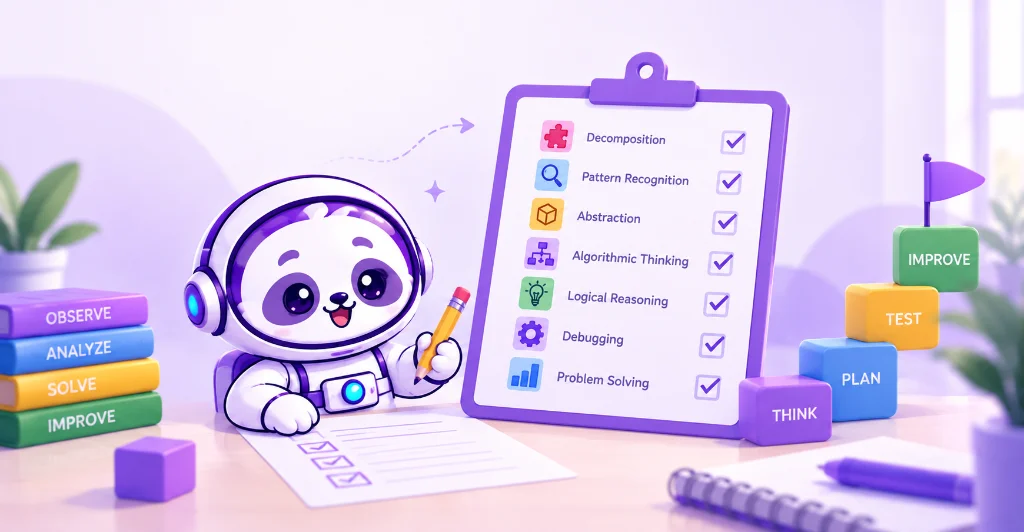
A practical school assessment framework focuses on seven observable competencies:
| Computational Thinking Skill | Observable Student Behaviors | Typical Classroom Manifestation |
|---|---|---|
| 1. Decomposition | Can the student deconstruct a complex, unstructured problem into manageable parts? | Creating sub-task outlines, organizing puzzle segments, flowcharts |
| 2. Pattern Recognition | Can the student identify repetition, structural relationships, or data trends? | Sequence deduction, matrix reasoning, historical trend mapping |
| 3. Abstraction | Can the student isolate necessary operational details and omit irrelevant noise? | Distilling word problems, designing minimal maps or icons |
| 4. Algorithmic Thinking | Can the student create deterministic, ordered, and unambiguous instructions? | Writing recipes, navigation cards, pseudo-code flowcharts |
| 5. Logical Reasoning | Can the student apply rules consistently and defend why a conclusion is sound? | Deductive proofs, constraint satisfaction puzzles, cipher audits |
| 6. Debugging & Iteration | Can the student locate errors, test hypotheses, and refine flawed instructions? | Bug hunts, correcting broken instructions, rule revision |
| 7. Problem Explanation | Can the student articulate why their solution operates effectively? | Verbal walkthroughs, 2-minute student reflections |
These seven pillars align with the competencies embedded in Codju’s CT & AI Learning Ecosystem, which monitors student growth across Decomposition, Pattern Recognition, Algorithmic Thinking, and Logical Reasoning.
Teachers do not need to assess all seven skills simultaneously in every class. A Mathematics period can evaluate decomposition and logical reasoning, while an English or Science period can focus on pattern recognition, sequencing, and abstraction.
2. Do Not Make the Final Answer the Only Evidence
Consider two students faced with an identical multi-step challenge:
Student A guesses quickly and happens to reach the correct numerical output. However, when asked to explain how they arrived at that answer, they cannot describe the steps, cannot explain the rule, and cannot apply the logic to a slightly modified problem.
Student B decomposes the problem into three logical stages, designs an ordered algorithm, tests it, spots an error in Stage 2, repairs the bug, but makes a minor arithmetic slip in the final addition.
A grading system that looks only at the final number rewards Student A’s lucky guess while penalizing Student B’s exemplary computational reasoning.
A true Computational Thinking evaluation captures the entire cognitive pipeline:
$$\text{Initial Approach} \longrightarrow \text{Strategy Choice} \longrightarrow \text{Testing Phase} \longrightarrow \text{Error Response} \longrightarrow \text{Verbal Justification}$$
3. Four Multidimensional Assessment Methods
A balanced CT evaluation framework synthesizes multiple forms of student evidence rather than relying on a single high-stakes written exam:
Hands-on puzzles, mazes, and tangible problem projects.
Critique, debug, and remix flawed logical procedures.
2-minute verbal defense and explanation of reasoning.
Portfolios, error logs, and student self-reflections.
A. Practical Hands-On Tasks
Give students an authentic, tangible challenge where they must apply problem-solving techniques.
- Classes 3–5 Examples:
- Guide a classmate through an obstacle maze using pre-written directional arrow cards (Algorithmic Thinking & Debugging).
- Identify the governing rule behind an incomplete geometric tile sequence (Pattern Recognition).
- Arrange a shuffled 6-card comic into causal order and justify the sequence (Logical Sequencing).
- Decompose a morning routine into prerequisite dependencies (Decomposition).
- Classes 6–8 Examples:
- Repair a flawed decision flowchart containing infinite loops (Debugging & Algorithmic Branching).
- Deconstruct an algebra word problem into known constants, intermediate equations, and target variables (Decomposition).
- Audit a classroom survey dataset to identify trends and potential sampling bias (Data Literacy & Pattern Recognition).
- Formulate a substitution cipher algorithm and write decryption instructions for a peer (Data Encoding).
(Explore ready-to-run classroom tasks in our collection of 25 Computational Thinking Activities for Classes 3–8 — No Coding Required.)
B. Design Scenarios (Critique & Debug)
Rather than starting from a blank page, provide students with an existing, imperfect procedure and ask them to audit it.
Example Classroom Scenario:
“Here is an algorithm designed to help a cleaning robot vacuum the school hallway without bumping into lockers. The robot gets stuck at Corner 3. Analyze the instruction sequence, identify where it fails, explain why the bug occurs, and rewrite the sequence to prevent deadlock.”
This approach reflects Harvard’s Design Scenario Assessment, testing whether students can read, evaluate, critique, and remix computational systems created by others.
C. Student Explanation (The 2-Minute Inquiry)
A student’s written worksheet often masks their real mental model. Conduct brief, 2-minute verbal check-ins using five diagnostic questions:
- “What was the very first decision your team made before writing instructions?”
- “Why did you choose this sequence rather than doing Step B first?”
- “When your initial plan failed, how did you locate the bug?”
- “What details did you intentionally ignore to make this easier?”
- “How can you prove to me that your solution will work every single time?”
These questions make the thinking visible, distinguishing rote memory from conceptual mastery.
D. Learner Documentation & Reflective Journals
Encourage students to maintain a concise CT Reflection Log. This does not need to be an onerous essay; a simple 5-question template is sufficient:
Reflective documentation captures the evolution of student thinking over time and serves as authentic portfolio evidence for parent-teacher conferences and academic portfolios.
4. The Codju 4-Level CT Mastery Framework
To help schools structure performance evaluation without academic complexity, Codju outlines a clear four-tier mastery progression:
| Level | Performance Tier | Demonstrated Student Capacity | Primary Cognitive Mode |
|---|---|---|---|
| Level 1 | Identify | Recognizes problems, visual patterns, and rules when prompted with teacher support. | Guided Observation |
| Level 2 | Apply | Independently selects and executes an appropriate CT strategy to solve a familiar problem. | Procedural Application |
| Level 3 | Explain & Improve | Articulates the logic behind the solution, isolates bugs, and refines the procedure. | Iterative Optimization |
| Level 4 | Transfer & Justify | Successfully adapts the problem-solving strategy to novel disciplines and defends why it works. | Conceptual Transfer |
A student who transitions from merely spotting a pattern to applying it independently, debugging errors, and transferring that logic to a Science or Math problem has achieved true computational literacy.
5. Comprehensive Classroom CT Assessment Rubric
Teachers can use this 4-point rubric to evaluate individual student work across unplugged activities, lab challenges, and collaborative group tasks:
| Computational Skill | 1 — Beginning | 2 — Developing | 3 — Proficient | 4 — Advanced |
|---|---|---|---|---|
| Decomposition | Unable to break down tasks without continuous teacher prompts. | Identifies 1–2 broad parts but misses critical sub-components. | Independently decomposes the problem into logical, manageable parts. | Decomposes complex problems efficiently and identifies dependencies between parts. |
| Pattern Recognition | Only notices obvious, surface-level visual similarities. | Identifies simple repetitions but struggles to state the governing rule. | Clearly articulates the underlying rule and accurately predicts the next state. | Generalizes observed patterns and transfers the rule to novel, unencountered problems. |
| Abstraction | Gets overwhelmed by minor details; includes everything. | Removes some surface details but retains unnecessary information. | Systematically filters out irrelevant noise to focus on core operational rules. | Constructs elegant, simplified models (maps, icons, pseudocode) that others can execute. |
| Algorithmic Thinking | Instructions are missing, out of order, or ambiguous. | Creates a mostly ordered sequence, but contains gaps requiring assumptions. | Produces clear, step-by-step instructions that run without ambiguity. | Designs optimal, efficient algorithms with conditional branching (IF-THEN) and loops. |
| Logical Reasoning | Guesses outcomes without explaining any reasoning. | Follows rules partially; makes inconsistent deductions. | Consistently applies rules, tests constraints, and explains conclusions. | Compares multiple possible logic paths, eliminates dead-ends, and justifies choices. |
| Debugging & Iteration | Abandons the task when an error occurs; needs teacher intervention. | Identifies that an error exists, but cannot locate the root cause. | Systematically isolates the bug, tests a fix, and repairs the procedure. | Anticipates edge cases, designs preventive tests, and iteratively optimizes efficiency. |
| Explanation & Reflection | Cannot articulate how or why the answer was reached. | Describes what was done, but cannot explain the underlying logic. | Clearly explains the solution, step-by-step logic, and testing methods. | Evaluates alternative approaches, defends strategic decisions, and suggests extensions. |
This rubric shifts grading away from a subjective “good/bad” judgment to an objective, actionable diagnostic of student cognitive development.
6. Concrete Assessment Scenarios for Classes 3–5
Primary school students should demonstrate computational reasoning through physical, visual, and narrative activities.
One student acts as the "Robot" while another provides command cards (FORWARD 2, TURN RIGHT 90°) to navigate a classroom floor grid.
- Decomposition: Did the student plan the path in discrete, segmented legs?
- Algorithmic Thinking: Are commands unambiguous and correctly sequenced?
- Debugging: When the robot walks into a chair, does the student locate the specific command card that caused the collision?
- Explanation: Can the student explain how modifying that single card repairs the entire path?
Present the visual sequence: 🔴 🟦 🟦 🔴 🟦 🟦 🔴 ❓
- Question 1 (Recognition): "What shape comes next?" (Student answers:
🟦). - Question 2 (Reasoning): "Explain the secret rule that guarantees your answer is right." (Student explains: "The rule is 1 red circle followed by 2 blue squares. Since a red circle just appeared, the next two must be blue squares.").
Question 1 evaluates basic recognition; Question 2 evaluates computational logic.
7. Concrete Assessment Scenarios for Classes 6–8
Middle school students should tackle multi-variable systems, logic errors, data trends, and real-world planning.
Hand students a 10-line pseudocode algorithm for calculating student bus fares that contains three deliberate logic bugs (e.g., age discounts applied after totals, an unhandled division-by-zero, and an infinite loop on invalid inputs).
- Bug Identification: Does the student locate all three points of failure?
- System Trace: Can they explain why an edge-case input causes an infinite loop?
- Refinement: Can they rewrite the decision diamonds to handle edge cases cleanly?
Ask students to plan a School Science Fair involving 12 interdependent tasks (printing posters, booking the hall, inviting judges, arranging tables, electrical wiring).
- Decomposition: Did they identify all required operational phases?
- Dependencies: Do they recognize that "Setting up display tables" must precede "Arranging project models"?
- Optimization: Can they isolate the Critical Path—the exact chain of tasks where a 24-hour delay postpones the entire event?
8. Formative Assessment: The Daily Teacher Observation Checklist
Not every assessment requires a formal grade. Teachers can monitor daily classroom engagement using this rapid 10-point checklist:
This checklist requires seconds to mark during classroom activities and provides rich diagnostic data for quarterly progress reports.
9. Recommended Institutional Assessment Cadence
Schools do not need weekly high-stress exams. A sustainable, balanced annual calendar incorporates four assessment touchpoints:
- Diagnostic (Start of Term): A 20-minute unplugged challenge to establish where students stand in spatial reasoning and logic.
- Formative (Ongoing Weekly): Daily teacher checklists and 2-minute verbal inquiries during routine classwork.
- Unit Task (Every 4–6 Weeks): A collaborative design scenario or multi-step problem evaluated against the 4-point rubric.
- Summative Portfolio (End of Term): Student portfolio review featuring project flowcharts, error logs, and self-reflections.
10. Assessing Computational Thinking Across Disciplines
Computational Thinking is not an isolated subject confined to computer rooms. It is a universal cognitive problem-solving toolkit that can be assessed across the entire curriculum:
Task: Decompose a complex multi-step geometry or rate problem into sub-equations.
Assesses: Decomposition & Algorithmic ExecutionTask: Build a closed-loop state diagram modeling the Water Cycle or Photosynthesis.
Assesses: Systems Abstraction & State TransitionsTask: Map out the narrative plot structure, character motivations, and causal turning points.
Assesses: Pattern Recognition & Causal LogicTask: Extract recurring historical patterns leading to societal conflict across centuries.
Assesses: Pattern Recognition & Cross-Domain Abstraction11. What Schools Must Avoid in CT Assessment
To avoid common pedagogical traps, school leaders should audit their assessment policies against four red flags:
Asking students to write: "Decomposition is dividing a problem into parts." This tests vocabulary recall, not problem-solving ability.
Judging a project solely on whether it looks attractive, ignoring whether the student can explain the underlying logic.
Marking down a student for a missing colon or parenthesis while overlooking excellent procedural logic and error correction.
Treating mistakes as fatal errors. Debugging and iterative refinement are the essence of computational thinking.
How Codju Supports Seamless CT Assessment
Codju Technologies delivers a turnkey ecosystem designed to make competency-based assessment effortless for schools:
Codju’s AI Labs 360° platform tracks student problem-solving habits in real time. Teachers receive granular dashboards mapping student proficiency across Decomposition, Pattern Recognition, Algorithmic Logic, and Debugging without manual grading burden.
Our Accel AI Textbooks (Grades 1–8) incorporate pre-designed self-assessment rubrics, challenge reflection prompts, and teacher evaluation keys aligned with CBSE 2026–27 and NCF 2023 mandates.
We conduct professional capacity-building workshops that train subject teachers and computer faculties to conduct 2-minute verbal inquiries, evaluate design scenarios, and track cognitive growth with confidence.
Frequently Asked Questions
How do you assess Computational Thinking?
Assess students through practical problem-solving tasks, design scenarios, classroom observation, student verbal explanations, reflective documentation, and structured competency rubrics rather than rote definition tests.
What is a Computational Thinking assessment?
A Computational Thinking assessment measures how students apply core problem-solving practices—such as decomposition, pattern recognition, abstraction, algorithmic logic, and debugging—to analyze and solve challenges.
Can Computational Thinking be assessed without coding?
Yes. CT can be assessed through unplugged puzzles, physical activities, flowcharts, sequencing challenges, data investigation tasks, and classroom scenarios without requiring programming syntax or computer hardware.
What should a CT assessment rubric include?
A useful CT assessment rubric evaluates the student’s thinking process across defined levels (Beginning, Developing, Proficient, Advanced) across decomposition, pattern spotting, abstraction, algorithmic clarity, logical reasoning, debugging, and verbal justification.
Should CT be assessed separately from AI?
Not necessarily. Computational Thinking provides the prerequisite cognitive foundation for Artificial Intelligence. Assessing how students structure data, recognize patterns, and evaluate algorithms directly prepares and measures their readiness for machine learning concepts.
Final Takeaway
The most revealing question a teacher can ask in an assessment is not:
“Did the student get the answer right?”
The question that matters is:
“What cognitive decisions did the student make while solving the problem?”
- Did they break down the complexity?
- Did they recognize the governing pattern?
- Did they filter out the irrelevant distractions?
- Did they construct a logical, step-by-step procedure?
- Did they systematically locate and repair their errors?
- And, most importantly, can they articulate their thinking clearly to others?
That is the evidence forward-thinking schools use to cultivate genuine computational intelligence for the AI era.
Authoritative References & Recommended Reading
Official Frameworks & Research
- CBSE Official CT & AI Portal: Official curriculum guidelines and student/teacher resources for Classes III–VIII. CBSE Academic CT & AI
- Harvard Graduate School of Education ScratchEd: Assessing Computational Thinking frameworks, student rubrics, and design scenarios. ScratchEd CT Assessment Guide
- MIT Media Lab: Research on new frameworks for studying and assessing computational thinking development. MIT Media Lab Frameworks
Related Codju Guides
- How Schools Can Implement Computational Thinking & AI: A 7-Step Framework — The school-implementation pillar roadmap.
- 25 Computational Thinking Activities for Classes 3–8 — No Coding Required — Ready-to-use classroom tasks mapped to CT skills.
- CBSE Computational Thinking Classes 3–8: What Students Learn at Each Stage — Class-by-class learning outcomes and syllabi.
- What Is Computational Thinking? Complete Guide for Schools — The foundational guide to the 4 pillars.
- 5 Classroom Activities to Teach Computational Thinking (No Coding Required) — Hands-on unplugged activities.
- From Zero to Teaching Computational Thinking in 7 Days — Actionable teacher onboarding plan.
FAQ
Frequently Asked Questions
How do you assess Computational Thinking?
Assess students through practical problem-solving tasks, design scenarios, classroom observation, student verbal explanations, reflective documentation, and structured competency rubrics rather than rote definition tests.
What is a Computational Thinking assessment?
A Computational Thinking assessment measures how students apply core problem-solving practices—such as decomposition, pattern recognition, abstraction, algorithmic logic, and debugging—to analyze and solve challenges.
Can Computational Thinking be assessed without coding?
Yes. CT can be assessed through unplugged puzzles, physical activities, flowcharts, sequencing challenges, data investigation tasks, and classroom scenarios without requiring programming syntax or computer hardware.
What should a CT assessment rubric include?
A useful CT assessment rubric evaluates the student's thinking process across defined levels (Beginning, Developing, Proficient, Advanced) across decomposition, pattern spotting, abstraction, algorithmic clarity, logical reasoning, debugging, and verbal justification.
Should CT be assessed separately from AI?
Not necessarily. Computational Thinking provides the prerequisite cognitive foundation for Artificial Intelligence. Assessing how students structure data, recognize patterns, and evaluate algorithms directly prepares and measures their readiness for machine learning concepts.
Continue Reading
All Computational Thinking articles →
CBSE Computational Thinking & AI Curriculum 2026–27: Complete Guide for Schools
Understand the CBSE Computational Thinking and AI curriculum 2026–27 for Classes 3–8, including class-wise learning, CT skills, AI concepts, resources and school implementation.
25 Computational Thinking Activities for Classes 3–8 — No Coding Required
Explore 25 no-coding Computational Thinking activities for Classes 3–8. Includes classroom setup, instructions, objectives and learning outcomes for CT, logic and problem-solving.

How Schools Can Implement Computational Thinking & AI: A 7-Step Framework
A practical 7-step implementation framework for schools introducing Computational Thinking and Artificial Intelligence, aligned with CBSE 2026–27 guidelines, NEP 2020, and UNESCO competency frameworks.

AI Literacy vs Digital Literacy: What Is the Difference for Students?
Understand the difference between AI literacy and digital literacy for students, including AI skills, source evaluation, misinformation, privacy, bias and responsible AI use.
Codju for Schools