
In this article
- 01 What Is the CBSE CT & AI Curriculum 2026–27?
- 02 Why CBSE Introduced CT & AI
- 03 Classes 3–5: Computational Thinking Comes First
- 04 Classes 6–8: CT Expands Directly Into Artificial Intelligence
- 05 Advanced Computational Thinking
- 06 Core Artificial Intelligence Domains
- 07 What Students Are Actually Developing
- 08 Does CBSE Require Coding From Class 3?
- 09 What the Curriculum Demands From Teachers
- 10 Institutional Readiness: The 5-Pillar School Checklist
- 11 1. Curriculum Mapping
- 12 2. Teacher Preparation
- 13 3. Classroom Materials
- 14 4. Timetable Allocation
- 15 5. Competency-Based Assessment
- 16 Official CBSE Requirements vs. Codju Implementation Recommendations
- 17 A 7-Phase Implementation Roadmap for 2026–27
- 18 Common Mistakes Schools Must Avoid
- 19 Frequently Asked Questions
- 20 What is the CBSE Computational Thinking and AI curriculum for 2026–27?
- 21 Which classes are covered under the CBSE CT & AI curriculum?
- 22 Is coding required from Class 3 in CBSE?
- 23 What are the core Computational Thinking skills in the CBSE curriculum?
- 24 What does the AI component include in Classes 6–8?
- 25 Where can schools access the official CBSE CT & AI resources?
- 26 Final Takeaway
- 27 Official Documents & Recommended Reading
- 28 Official Primary Sources
- 29 Related Codju Guides
The Central Board of Secondary Education has formally launched its Computational Thinking (CT) and Artificial Intelligence (AI) curriculum for Classes 3–8, scheduled for mandatory rollout starting from the 2026–27 academic session.
Introduced through official Circular Acad-15/2026, the Board explicitly aligned this curriculum with the recommendations of the National Education Policy (NEP 2020) and the National Curriculum Framework for School Education (NCF).
This is not merely a replacement for traditional computer classes or basic coding syntax. The official CBSE framework positions Computational Thinking as an overarching problem-solving approach—grounded in Decomposition, Pattern Recognition, Abstraction, Algorithm Design, Data Analysis, and Troubleshooting—designed to build the intellectual foundation for authentic AI literacy.
For school principals, management trustees, and academic coordinators, the practical challenge is straightforward:
What specifically changes between Class 3 and Class 8, and how does a school translate CBSE’s policy documents into engaging, manageable classroom execution?
This comprehensive guide breaks down the official CBSE framework, unpacks the class-wise progression, and provides an actionable institutional implementation roadmap.
What Is the CBSE CT & AI Curriculum 2026–27?
The CBSE CT & AI framework represents a unified developmental arc spanning the Preparatory Stage (Classes 3–5) and the Middle Stage (Classes 6–8). The official CBSE Academic CT & AI Portal has released both student workbooks and companion teacher resource handbooks for all six grade levels.
The curriculum is structured around two mutually reinforcing principles:
Decomposition • Pattern Recognition • Abstraction • Algorithm Design • Data Analysis • Troubleshooting
Data-Driven Logic • Machine Predictions • Computer Vision & NLP • Bias, Fairness & Ethics
Rather than jumping directly into complex programming or generative chatbot tools, students first develop the analytical habits required to understand how algorithmic systems process inputs, classify patterns, and make deterministic or probabilistic predictions.
Why CBSE Introduced CT & AI
The curriculum is direct fulfillment of national educational reforms:
- NEP 2020 Mandates: National policy calls for exposing young learners to emerging 21st-century capabilities—specifically Computational Thinking, Mathematical Thinking, Data Literacy, and Artificial Intelligence—well before secondary school board examinations.
- Transition from Tool Operation to Logical Reasoning: For decades, Indian school ICT syllabi focused on teaching office productivity software (Word, PowerPoint, Excel) or isolated programming syntax. CBSE is pivoting from memorizing software menus to thinking critically with technology.
- AI Readiness with Ethical Clarity: As AI systems proliferate, children must understand how automated algorithms operate, where errors originate, and how to interrogate automated outputs for bias, inaccuracies, and hallucinations.
Classes 3–5: Computational Thinking Comes First
In the Preparatory Stage (Classes 3–5), Computational Thinking is integrated into existing Mathematics and TWAU (The World Around Us / EVS) curricula rather than introduced as an isolated standalone subject with a separate exam.
CBSE’s official framework provides dedicated CT resource books aligned directly with the chapters of existing NCERT/CBSE textbooks. This allows classroom educators to teach CT habits seamlessly during normal subject periods:
- Visualizing 3D shapes from 2D nets
- Predicting spatial rotations, folds, and turns
- Identifying missing cells and hidden components
- Simple repeating and growing number/shape patterns
- Decomposing problems containing multiple narrative clues
- Multi-condition pattern deduction
- Sequential choreographies and step-by-step instructions
- Attribute sorting and classification tables
- Identifying the root cause of procedural errors (debugging)
- Evaluating everyday technology examples
- Structured distribution and optimization problems
- Multi-variable decomposition under real-world constraints
- Stepwise algorithmic planning with conditional rules
- Understanding differences between automation and AI
- Foundational bridge to middle-school AI concepts
For Classes 3–5, the classroom journey is entirely concrete:
$$\text{Observe} \longrightarrow \text{Identify Relationships} \longrightarrow \text{Deconstruct Problem} \longrightarrow \text{Reason Systematically} \longrightarrow \text{Construct Solution}$$
(Explore hands-on lesson ideas in our handbook: 25 Computational Thinking Activities for Classes 3–8 — No Coding Required.)
Classes 6–8: CT Expands Directly Into Artificial Intelligence
In the Middle Stage (Classes 6–8), computational rigor expands into formal data structures, algorithmic design, and introductory domains of Artificial Intelligence:
Advanced Computational Thinking
- Mathematical & Proportional Reasoning: Analyzing proportional scaling, ratios, and rates through computational algorithms.
- Geometric Configurations & Constraints: Applying constraint satisfaction algorithms to spatial layouts.
- Structured Data Representation: Gathering, organizing, tabulating, and visualizing data through multi-axis graphs.
- Algorithmic Design with Branching: Constructing decision trees, flowcharts, and conditional procedures (
IF-THEN-ELSE) to resolve multi-variable challenges.
Core Artificial Intelligence Domains
- Data-Driven Intelligence: Exploring how computers use datasets to train predictive machine learning models (supervised vs. unsupervised learning).
- Computer Vision & NLP: Hands-on conceptual exposure to how algorithms process visual pixels and parse human syntax.
- The 4-Stage AI Project Lifecycle:
Define Problem ➔ Collect Data ➔ Test AI Model ➔ Reflect & Refine. - Algorithmic Ethics & Societal Impact: Critical investigation of dataset bias, demographic fairness, digital footprints, intellectual property, and responsible usage.
What Students Are Actually Developing
A frequent misconception among educators is that this curriculum merely teaches students “how to prompt an AI chatbot.” The official CBSE matrix is substantially deeper:
| Curriculum Domain | Core Student Competencies Developed | Practical Classroom Manifestation |
|---|---|---|
| Decomposition | Breaking complex, unstructured problems into manageable sub-tasks. | Project outlines, mathematical quadrant models, event planning |
| Pattern Recognition | Identifying structural trends, shared attributes, and governing formulas. | Sequence analysis, classification matrices, historical trend spotting |
| Abstraction | Isolating essential operational rules while filtering out contextual noise. | Creating navigation maps, scientific state diagrams, pseudocode |
| Algorithm Design | Formulating deterministic, ordered instructions that run without ambiguity. | Flowcharts, recipes, obstacle navigation choreographies |
| Data Analysis | Collecting, tabulating, visualizing, and drawing inferences from data. | Survey matrices, scatter plots, dataset validation audits |
| Troubleshooting & Debugging | Isolating faults, testing hypotheses, and iteratively repairing logic. | ”Bug hunt” worksheets, peer logic audits, error logs |
| AI Literacy | Understanding how training data, algorithms, and models make predictions. | Machine learning simulations, image recognition tests |
| AI Ethics & Responsibility | Evaluating societal fairness, algorithmic bias, privacy, and accountability. | Case study inquests, hallucination verification checks |
(For grade-specific syllabus breakdown, consult CBSE Computational Thinking Classes 3–8: What Students Learn at Each Stage.)
Does CBSE Require Coding From Class 3?
No. The official framework explicitly rejects coding syntax as the entry point.
CBSE Circular Acad-18/2026 specifically highlights “AI + Ethics + Unplugged Learning” as the core instructional approach. The framework is not dependent on any proprietary programming language or expensive software platform.
Primary school classrooms can execute the entire Class 3–5 curriculum through:
- Card-sorting games and floor grid mazes;
- Physical manipulatives, attribute blocks, and tangrams;
- Illustrated logic puzzles and broken chronological stories;
- Tabular data collection and collaborative classroom debates.
This design guarantees that schools with limited computer lab infrastructure can achieve 100% compliance with CBSE learning outcomes without capital constraints.
What the Curriculum Demands From Teachers
The shift is fundamental. Teachers must transition from being software demonstrator instructors to inquiry facilitators.
- "Memorize the definition of an algorithm."
- "Click on File, then Save, then Format."
- "Here is the single correct textbook answer."
- "Follow my exact clicks on the screen."
- "How did you break down this multi-step problem?"
- "What pattern did you spot that made this easier?"
- "When your instructions failed, how did you locate the bug?"
- "Why would an AI system make an incorrect prediction here?"
Teachers do not need computer science degrees to succeed. They need structured activity materials and practical guidance on facilitating classroom inquiry.
(For practical teacher enablement strategies, read AI for Teachers: 20 Practical Ways Teachers Can Use AI Without Losing the Human Touch.)
Institutional Readiness: The 5-Pillar School Checklist
CBSE has directed school administrations to initiate operational preparations. Schools should evaluate their readiness across five areas:
1. Curriculum Mapping
Ensure your academic calendar maps the official CT learning outcomes against existing textbook units in Mathematics, Science, and Social Studies.
2. Teacher Preparation
Provide non-technical primary educators and computer faculties with specialized professional development focused on activity facilitation, error debugging, and ethical AI discussions.
3. Classroom Materials
Equip teachers with structured, grade-wise student workbooks, puzzle sheets, flowchart stencils, and manipulative kits alongside lightweight digital platforms.
4. Timetable Allocation
The official CBSE framework suggests an annual guideline of:
- Classes 3–5: 50 instructional hours annually (embedded within Math and TWAU).
- Classes 6–8: 100 instructional hours annually (divided across Advanced CT, Introductory AI, and Interdisciplinary Projects).
5. Competency-Based Assessment
Align your internal evaluation with CBSE’s SAFAL initiative (Structured Assessment for Analyzing Learning), prioritizing higher-order analytical thinking over rote memorization.
(For detailed evaluation rubrics, refer to How Should Schools Assess Computational Thinking? A Practical Assessment Guide.)
Official CBSE Requirements vs. Codju Implementation Recommendations
To ensure absolute administrative clarity, school leaders should distinguish between the Board’s official mandate and third-party implementation solutions:
- Establishes statutory learning outcomes and grade coverage (Classes 3–8).
- Mandates integration into Mathematics and TWAU for preparatory grades.
- Prescribes the core 6 CT skill areas and AI ethics expectations.
- Publishes benchmark student and teacher resource circulars.
- Provides turnkey Accel AI Textbooks (Grades 1–8) aligned to CBSE.
- Supplies AI Labs 360° with 200+ browser simulations & 50+ AI games.
- Delivers TeachBoost professional workshops and lesson plans.
- Automates real-time competency analytics and grading rubrics.
Codju does not replace the CBSE curriculum; Codju operationalizes the CBSE curriculum so that school teachers can execute it effortlessly in real classrooms.
A 7-Phase Implementation Roadmap for 2026–27
School leadership can execute a smooth institutional transition by following this sequential roadmap:
(For executive governance guidance, read How Schools Can Implement Computational Thinking & AI: A 7-Step Framework.)
Common Mistakes Schools Must Avoid
- Treating CT as “Coding for Younger Kids”: Programming syntax is only one small implementation tool. Computational Thinking is the universal cognitive framework of problem decomposition, pattern recognition, and logic.
- Treating AI as a Standalone Tool Tutorial: Teaching students how to prompt ChatGPT or Midjourney is not AI literacy. Students must understand data training, predictive statistical models, and algorithmic bias.
- Purchasing Expensive Hardware Prematurely: Do not spend lakhs on high-end computer lab GPUs or proprietary robotics hardware. The preparatory curriculum is predominantly unplugged and runs on existing standard web browsers.
- Neglecting Teacher Professional Training: Handing teachers a new textbook without training leads to anxiety and superficial memorization drills. Invest in teacher capacity building first.
- Evaluating Only Rote Definitions: A written exam asking students to define “abstraction” evaluates vocabulary, not thinking. Assess demonstrated problem solving.
Frequently Asked Questions
What is the CBSE Computational Thinking and AI curriculum for 2026–27?
It is an official CBSE curriculum framework for Classes 3–8 launched from the 2026–27 session via Circular Acad-15/2026. It establishes Computational Thinking as the foundational cognitive prerequisite for Artificial Intelligence, aligned with NEP 2020 and NCF.
Which classes are covered under the CBSE CT & AI curriculum?
Classes 3 through 8 are covered by the 2026–27 framework. CBSE provides grade-specific student and teacher resource handbooks for Grades 3, 4, 5, 6, 7, and 8.
Is coding required from Class 3 in CBSE?
No. The framework does not begin with programming syntax. For Classes 3–5, Computational Thinking is embedded into existing Mathematics and TWAU (The World Around Us) subjects using unplugged puzzles, spatial reasoning, and pattern recognition without requiring computers.
What are the core Computational Thinking skills in the CBSE curriculum?
The official CBSE framework identifies Decomposition, Pattern Recognition, Abstraction, Algorithm Design, Data Analysis, and Troubleshooting.
What does the AI component include in Classes 6–8?
In the Middle Stage (Classes 6–8), AI expands into data-driven decision-making, pattern recognition in machine learning, Computer Vision, NLP, the 4-stage AI project lifecycle, and critical ethics around bias and fairness.
Where can schools access the official CBSE CT & AI resources?
CBSE’s official academic portal provides the curriculum framework document, circulars Acad-15/2026 and Acad-18/2026, and downloadable student and teacher handbooks for Grades 3–8.
Final Takeaway
The introduction of the CBSE 2026–27 Computational Thinking & AI Curriculum marks a historic shift in Indian education:
From memorizing answers to formulating questions.
From operating software to understanding systems.
From passive technological consumers to critical, ethical creators.
Schools that embrace this framework will not simply comply with a regulatory board mandate—they will empower a generation of children to think clearly, solve fearlessly, and thrive in an AI-powered world.
Official Documents & Recommended Reading
Official Primary Sources
- CBSE Official CT & AI Portal: Official curriculum circulars, student handbooks, and teacher resources. CBSE CT & AI Portal
- CBSE Circular Acad-15/2026: Launch of the CT & AI Curriculum for Classes III–VIII. CBSE Circular Acad-15/2026 (PDF)
- CBSE Circular Acad-18/2026: Student and Teacher Resource Books for CT & AI. CBSE Circular Acad-18/2026 (PDF)
- CBSE CT & AI Curriculum Framework 2026–27: Complete curriculum document. CBSE Curriculum Document (PDF)
Related Codju Guides
- How Schools Can Implement Computational Thinking & AI: A 7-Step Framework — The complete institutional implementation blueprint.
- CBSE Computational Thinking Classes 3–8: What Students Learn at Each Stage — Comprehensive class-by-class syllabus breakdown.
- 25 Computational Thinking Activities for Classes 3–8 — No Coding Required — Ready-to-use classroom tasks.
- How Should Schools Assess Computational Thinking? A Practical Assessment Guide — Competency rubrics and observation checklists.
- AI for Teachers: 20 Practical Ways Teachers Can Use AI Without Losing the Human Touch — Practical classroom workflows for educators.
- What Is Computational Thinking? Complete Guide for Schools — The foundational guide to the 4 pillars.
FAQ
Frequently Asked Questions
What is the CBSE Computational Thinking and AI curriculum for 2026–27?
It is an official CBSE curriculum framework for Classes 3–8 launched from the 2026–27 session via Circular Acad-15/2026. It establishes Computational Thinking as the foundational cognitive prerequisite for Artificial Intelligence, aligned with NEP 2020 and NCF.
Which classes are covered under the CBSE CT & AI curriculum?
Classes 3 through 8 are covered by the 2026–27 framework. CBSE provides grade-specific student and teacher resource handbooks for Grades 3, 4, 5, 6, 7, and 8.
Is coding required from Class 3 in CBSE?
No. The framework does not begin with programming syntax. For Classes 3–5, Computational Thinking is embedded into existing Mathematics and TWAU (The World Around Us) subjects using unplugged puzzles, spatial reasoning, and pattern recognition without requiring computers.
What are the core Computational Thinking skills in the CBSE curriculum?
The official CBSE framework identifies Decomposition, Pattern Recognition, Abstraction, Algorithm Design, Data Analysis, and Troubleshooting.
What does the AI component include in Classes 6–8?
In the Middle Stage (Classes 6–8), AI expands into data-driven decision-making, pattern recognition in machine learning, Computer Vision, NLP, the 4-stage AI project lifecycle, and critical ethics around bias and fairness.
Where can schools access the official CBSE CT & AI resources?
CBSE's official academic portal provides the curriculum framework document, circulars Acad-15/2026 and Acad-18/2026, and downloadable student and teacher handbooks for Grades 3–8.
Continue Reading
All Computational Thinking articles →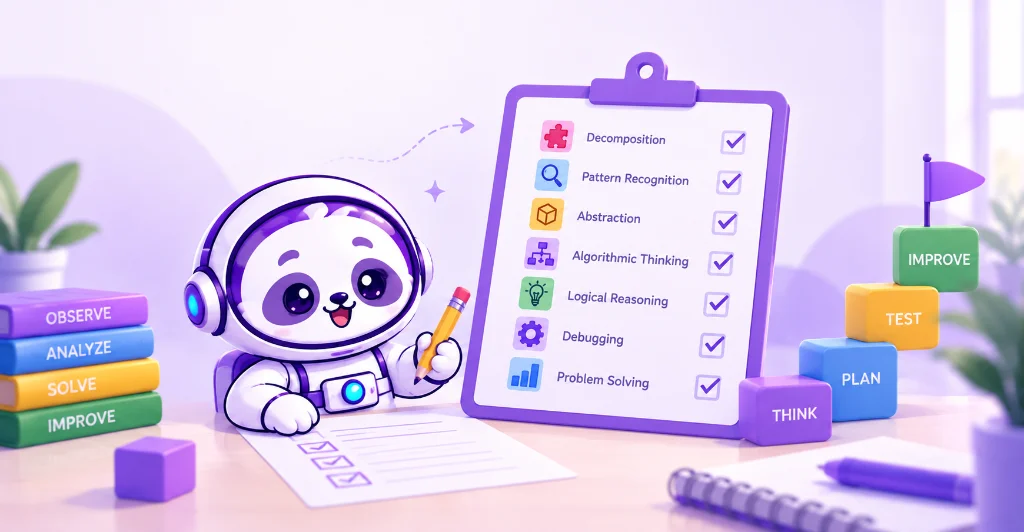
How Should Schools Assess Computational Thinking? A Practical Assessment Guide
Learn how to assess Computational Thinking in Classes 3–8 with practical tasks, CT assessment rubrics, formative assessment methods and classroom examples.
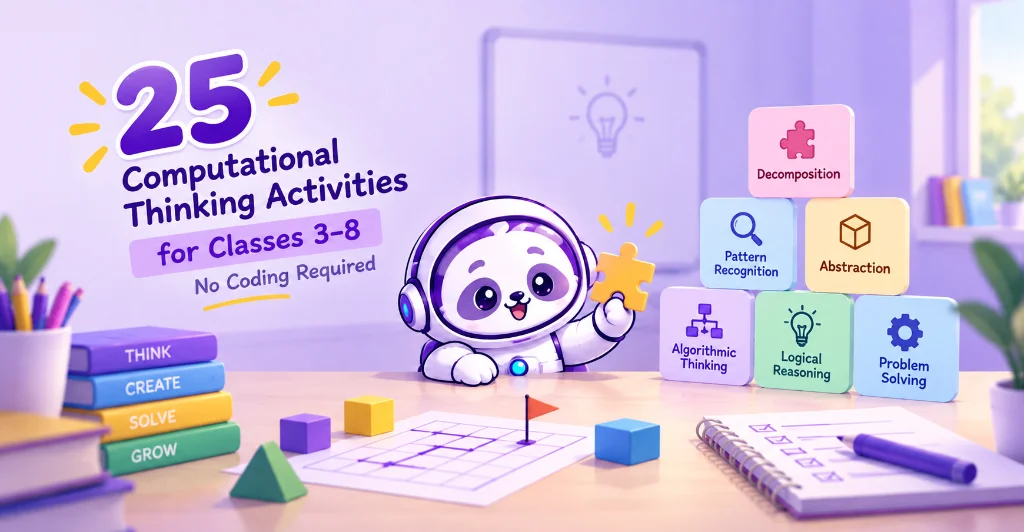
25 Computational Thinking Activities for Classes 3–8 — No Coding Required
Explore 25 no-coding Computational Thinking activities for Classes 3–8. Includes classroom setup, instructions, objectives and learning outcomes for CT, logic and problem-solving.

How Schools Can Implement Computational Thinking & AI: A 7-Step Framework
A practical 7-step implementation framework for schools introducing Computational Thinking and Artificial Intelligence, aligned with CBSE 2026–27 guidelines, NEP 2020, and UNESCO competency frameworks.
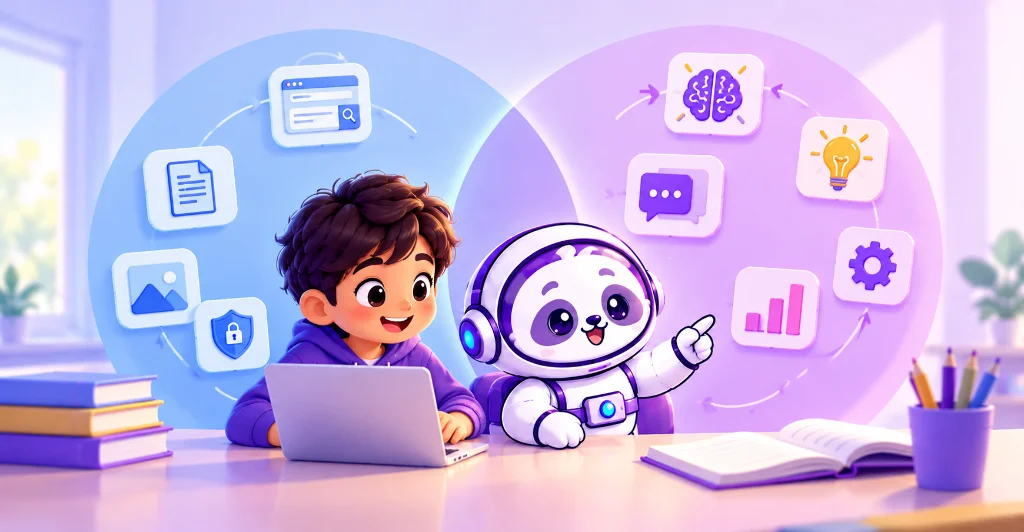
AI Literacy vs Digital Literacy: What Is the Difference for Students?
Understand the difference between AI literacy and digital literacy for students, including AI skills, source evaluation, misinformation, privacy, bias and responsible AI use.
Codju for Schools